VertexFlow Tubes stainless steel tube manufacturer logo VertexFlow TubesPrecision SS Tubing

How to Choose Brushed Gold Embossed Stainless Tube?

Time:2026-10-03 Author:Henry
0%

Choosing the right Brushed Gold Embossed Stainless Tube requires more than comparing color samples. The surface must support the project’s function, setting, and maintenance expectations.

Start with the stainless steel grade. Grade 304 suits many indoor applications, including handrails, furniture frames, and decorative partitions. Grade 316 offers stronger resistance in humid or coastal environments. Ask suppliers for material certificates and test reports. These documents help verify composition, finish consistency, and manufacturing quality.

Examine the embossing closely. The pattern should remain even along the full tube length, without flattened areas, sharp burrs, or visible dents. Run a clean cloth across the surface. It should move smoothly, not catch on unfinished edges. Check the gold coating under warm and cool lighting, because color can change noticeably between showrooms and real interiors. A reliable supplier should provide samples, coating details, tolerances, and care instructions before production.

Consider wall thickness, tube diameter, connection methods, and installation space together. A beautiful tube can still fail if its load capacity or bending tolerance is ignored. For exterior use, confirm resistance to moisture, ultraviolet exposure, and cleaning chemicals. Do not rely only on photographs. Physical inspection is better.

No single finish suits every space. Some embossed patterns collect dust more easily than expected. That detail deserves honest review. Compare samples after wiping, touching, and viewing them from different angles. Then select the tube that balances appearance, durability, verified specifications, and practical maintenance. That balance usually creates a more dependable result than choosing the brightest gold.
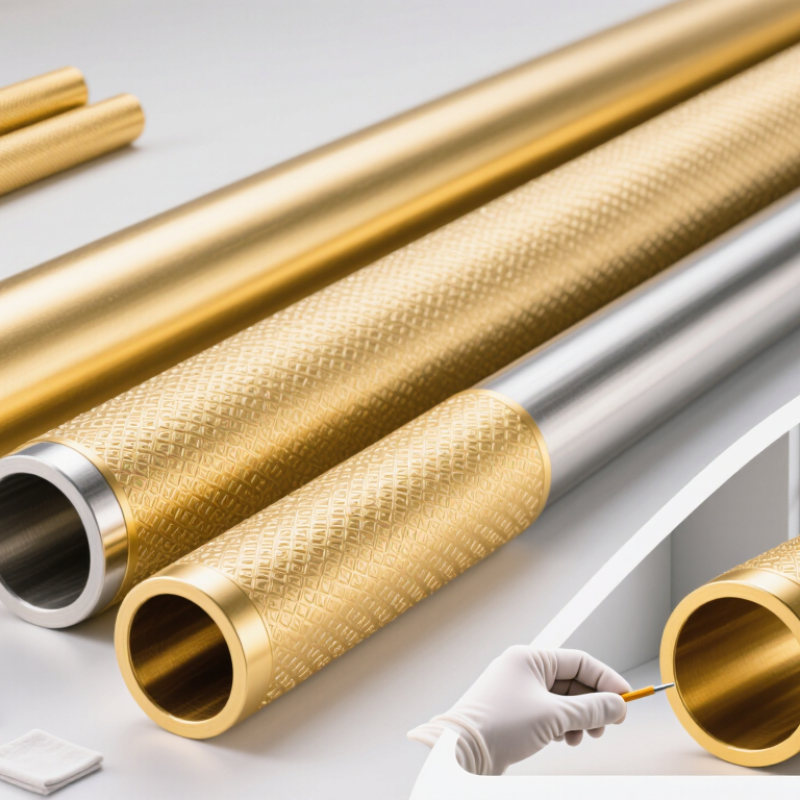
How to Choose Brushed Gold Embossed Stainless Tube?

Define Service Conditions: Match ASTM A554 Tubing to Load and Exposure

How to Choose Brushed Gold Embossed Stainless Tube?

Define Service Conditions: Match ASTM A554 Tubing to Load and Exposure

Before selecting a brushed gold embossed stainless tube, identify its real working environment. ASTM A554 covers welded stainless mechanical tubing, including dimensional tolerances, surface finishes, and selected grades. It does not automatically make the tube suitable for pressure service. Calculate bending, impact, vibration, span length, and wall-thickness requirements first. A decorative profile may look rigid, yet embossing can change local stress behavior.

Exposure matters just as much. ISO 9223 classifies atmospheric corrosivity from C1 to CX, while coastal spray, pool chemicals, road salt, and cleaning agents can attack exposed surfaces. The NACE IMPACT study estimated global corrosion costs at about 2.5 trillion dollars annually, equal to roughly 3.4% of global GDP. That figure is a warning, not a design shortcut. Select the stainless grade according to chloride levels, humidity, temperature, and maintenance frequency. Gold coloring is usually a surface treatment, so scratched areas may behave differently from intact surfaces.

I would request mill certificates, weld inspection records, and coating adhesion data. Ask for test results after abrasion and chemical exposure, not only photographs. ASTM A554 compliance supports dimensional confidence, but it cannot predict every installation failure. A showroom sample can mislead. For demanding outdoor or marine applications, review drainage, crevices, fasteners, and galvanic contact with a qualified engineer. Small details often decide service life.

How to Choose Brushed Gold Embossed Stainless Tube?

Define Service Conditions: Match ASTM A554 Tubing to Load and Exposure

Use the chart as a preliminary load-screening tool. ASTM A554 covers welded stainless steel mechanical tubing, including dimensional and surface requirements. For brushed or embossed decorative tubing, select the grade by considering structural load, chloride or chemical exposure, forming needs, and the required surface finish.

The values below are representative minimum room-temperature mechanical properties commonly used for preliminary comparison: yield strength indicates resistance to permanent deformation, while tensile strength indicates ultimate strength. Confirm the current ASTM A554 edition, material certificate, wall thickness, weld condition, and engineering design before final selection. ASTM A554 alone does not establish a pressure rating.

Choose Grade: Compare 304 with 18% Cr and 316L with 2–3% Mo

How to Choose Brushed Gold Embossed Stainless Tube?

The base grade matters more than the gold appearance. Grade 304 contains about 18% chromium and offers dependable indoor corrosion resistance. It suits wall panels, retail displays, hotel interiors, and dry residential spaces. I have inspected 304 tubes that stayed bright for years when cleaning was gentle and regular. Fingerprints still appear on brushed surfaces.

Grade 316L contains similar chromium, plus 2–3% molybdenum. This addition improves resistance to pitting caused by chlorides, salt air, and pool chemicals. Choose 316L for coastal balconies, spa rooms, marine-adjacent interiors, and frequently washed areas. Its low carbon content also supports cleaner welded joints after fabrication. It costs more, but replacement work can cost far more.

Look closely at the embossed grooves. Moisture and cleaning residue can remain in narrow patterns. A smoother embossing design is easier to wipe and inspect. Confirm the actual material certificate, not only the seller’s description. Check tube thickness, weld quality, surface uniformity, and edge finishing before installation. The brushed gold layer is decorative; it does not turn 304 into 316L. That distinction is often missed. I once underestimated cleaning exposure on an indoor project, and the nearby chlorine source changed the decision. My original selection was acceptable, but not ideal. Consider the environment honestly. Fancy finishes cannot repair a poor grade choice.

How to Choose Brushed Gold Embossed Stainless Tube? - Choose Grade: Compare 304 with 18% Cr and 316L with 2–3% Mo

Selection Criterion 304 Stainless Steel 316L Stainless Steel Practical Recommendation for Brushed Gold Embossed Tube
Main alloy family Austenitic chromium-nickel stainless steel Austenitic chromium-nickel-molybdenum stainless steel Both grades are suitable for decorative tube, but the service environment should determine the final choice.
Chromium content Typically 18–20% Cr Typically 16–18% Cr Chromium forms the passive oxide layer that provides basic corrosion resistance.
Nickel content Typically 8–10.5% Ni Typically 10–14% Ni Nickel supports the stable austenitic structure and improves formability and toughness.
Molybdenum content Not intentionally added; generally no more than about 0.75% Typically 2–3% Mo 316L is preferred where chlorides, coastal air, de-icing salts, or cleaning chemicals may cause pitting.
Carbon limit Usually up to 0.08% for 304 Maximum 0.03% for 316L The low-carbon 316L grade reduces sensitization risk after welding and is useful for welded tube assemblies.
Minimum yield strength, annealed product Approximately 205 MPa Approximately 170 MPa Both provide adequate strength for many architectural applications; confirm the tube standard and temper for actual values.
Minimum tensile strength, annealed product Approximately 515 MPa Approximately 485 MPa Actual mechanical properties can change with cold working, wall thickness, and manufacturing method.
General corrosion resistance Good in normal indoor, architectural, and mildly industrial conditions Very good, especially in chloride-containing and marine-influenced conditions Choose 304 for dry interiors; choose 316L for humid, coastal, poolside, or chemically exposed locations.
Resistance to chloride pitting Moderate; more vulnerable to localized pitting in salt exposure Higher resistance because of 2–3% molybdenum 316L is the safer choice when salt deposits or chloride-bearing cleaners are difficult to control.
Formability and embossing Excellent ductility and widely used for formed tube Excellent ductility, but may require higher forming force Both can be embossed; validate pattern depth, corner radius, springback, and surface uniformity through sampling.
Weldability Very good; 304L is preferred when a low-carbon version is required Very good; 316L is already low carbon For welded decorative frames or handrails, specify suitable welding procedures and post-weld cleaning.
Brushed surface compatibility Excellent; common finishes include No. 4 and finer directional brushing Excellent; supports the same general brushed finish options Specify grit, brushing direction, roughness target, weld blending, and allowable color variation.
Brushed gold appearance The gold color is not an inherent property of 304 The gold color is not an inherent property of 316L Gold appearance normally requires a compatible decorative coating or PVD process applied over the prepared stainless surface.
Relative material cost Generally lower because it does not contain intentional molybdenum Generally higher because of increased nickel and molybdenum content Use 304 where exposure is mild; the higher initial cost of 316L may be justified by longer service life in aggressive environments.
Recommended application environment Interior decoration, furniture, retail displays, offices, hotels, and dry architectural spaces Coastal architecture, outdoor installations, pool areas, kitchens, medical spaces, and chemical-cleaning environments Match the grade to humidity, salt, pollutants, cleaning agents, and maintenance frequency.
Typical selection guidance Best value for standard decorative use Best protection for demanding environments Choose 304 for cost efficiency and 316L when chloride resistance, low carbon, and long-term durability are priorities.

Note: Chemical compositions and mechanical properties are typical specification values for wrought stainless steel products and may vary by applicable standard, product form, thickness, and manufacturing condition. Always verify the required tube standard, wall thickness, finish, coating system, and test documentation before production.

Specify Brushing: Select ASTM A480 No. 4 Finish and a Ra Target

For brushed gold embossed stainless tube, specify the base surface before adding color or texture. ASTM A480/A480M defines No. 4 as a mechanically polished, brushed finish, but it does not assign one universal Ra value. That detail matters. Two tubes can carry the same No. 4 description yet reflect light differently.

A practical purchasing specification can state: “ASTM A480 No. 4 finish, target Ra 0.4–0.8 μm, measured after brushing and before coating.” This range is widely used for controlled decorative stainless surfaces, although actual results depend on abrasive grit, brushing pressure, and tube geometry. Euro Inox guidance also stresses that surface appearance depends on direction, uniformity, and inspection lighting, not roughness alone. Ra is only one number.

Ask the supplier to measure Ra with a calibrated contact profilometer under ISO 21920 procedures. Require readings from several locations, including the embossed area and the tube seam. A single measurement can mislead. Inspect a full-length sample under diffuse light, then view it at an angle. Brushing marks should run consistently, without deep cross-scratches or cloudy patches.

Gold coating can soften visible contrast, but it will not hide poor preparation reliably. In my experience, the specification often fails because “No. 4” is treated as a visual promise. It is not precise enough. Confirm the Ra limit, measurement direction, sampling points, and approved master sample in writing. ASTM A480/A480M-24; ISO 21920; Euro Inox surface-finish guidance.

Control Embossing: Check Pattern Depth, Wall Thickness, and EN 10217 Tolerances

How to Choose Brushed Gold Embossed Stainless Tube?

Embossing changes more than appearance. It can reduce the tube’s remaining wall at pattern valleys. Measure both the original wall and the thinnest finished area. A calibrated ultrasonic gauge helps, while a profilometer records embossing depth. Do not rely on touch or reflected light. Brushed gold coatings can hide shallow cracks and uneven polishing. EN 10217-7 covers welded stainless tubes for pressure purposes, but it does not create one universal embossing-depth limit. Confirm the selected outside diameter, wall-thickness class, length, and applicable EN 10217 tolerances in the purchase specification. The 2023 World Stainless statistics reported 58.4 million tonnes of crude stainless steel production worldwide. High volume does not guarantee consistent decorative tubing.

Tips: Request a sample cross-section, not only a polished photograph. Check pattern depth at several points around the circumference. Record minimum wall thickness after forming. Compare outside diameter with the permitted EN 10217 tolerance, using the relevant EN ISO 1127 dimensional table where specified. A tube may look straight yet fail roundness checks. Small errors become visible near couplings.

One practical weakness is uneven sampling. Inspecting one end can miss die wear near the middle. Use a defined gauge length and repeat measurements from both ends. Also verify weld quality after embossing, because forming can expose imperfections. I would reject vague claims such as “standard tolerance.” The exact class matters. In my view, visual approval should come last, after dimensions, pattern depth, and minimum wall thickness are documented. Some buyers still skip that step. They often regret it.

Verify Gold PVD: Require ASTM D3359 Adhesion Rating of 4B or Better

How to Choose Brushed Gold Embossed Stainless Tube?

Verify Gold PVD adhesion before judging color or texture. ASTM D3359 rates 4B when less than 5% of the tested coating area detaches after cutting and tape removal. That threshold matters. Brushed grooves can hide small lifted edges, especially around embossed details and tube corners. Request a report showing the exact stainless grade, surface preparation, coating batch, film thickness, cutter spacing, tape type, and test photographs. The test should use the finished tube, not a smooth laboratory panel.

Do not treat 4B as proof of complete weather resistance. Adhesion is only one performance factor. The NACE IMPACT study estimated global corrosion costs at about 2.5 trillion US dollars annually, equal to roughly 3.4% of global GDP. That figure explains why coating verification deserves more than a visual inspection. Ask for additional evidence, such as humidity, thermal-cycle, or salt-spray testing under suitable standards. ASTM B117 salt spray can support corrosion evaluation, but it does not replace ASTM D3359 adhesion testing.

A practical check is simple. Inspect cut intersections under strong light. Look for flakes, dark lines, or exposed steel. I would also test a sample after handling and installation simulation. A perfect appearance can still fail later. The weak point is often preparation, not the gold film itself. Reports should identify test dates and specimen quantities; one successful panel is not convincing evidence.

FAQS

Which stainless steel grade suits indoor decorative tubing?

Grade 304 suits dry interiors, wall panels, displays, and hotel spaces. It contains about 18% chromium. Clean fingerprints gently and regularly. Brushed surfaces still show marks.

When should I choose 316L instead of 304?

Choose 316L near salt air, pool chemicals, spas, or frequently washed areas. It contains 2–3% molybdenum for better pitting resistance. It costs more. Replacement may cost more.

Can a gold finish improve a weaker stainless steel grade?

No. The decorative coating does not change the base metal. Gold-colored 304 remains 304. I once underestimated nearby chlorine exposure. My original choice was acceptable, but not ideal.

What should I inspect in embossed tube patterns?

Check grooves for trapped moisture, residue, and uneven polishing. Smoother patterns are easier to wipe and inspect. Narrow grooves need extra attention.

How can embossing affect tube strength?

Embossing may reduce wall thickness at pattern valleys. Measure the original wall and the thinnest finished area. Use calibrated ultrasonic equipment, not touch alone.

What dimensional details should a purchase specification include?

State outside diameter, wall-thickness class, length, and permitted dimensional tolerances. Measure several points around the circumference. A straight-looking tube can still fail roundness checks.

Is one polished sample enough for approval?

No. Request a cross-section sample and measurements from multiple locations. Inspect both ends and the middle. Die wear may appear near the center. One sample can mislead.

How should gold coating adhesion be checked?

Require an adhesion rating of 4B or better. Less than 5% of the tested area should detach after cutting and tape removal. Test the finished embossed tube, not a smooth panel.

Does a strong adhesion result prove outdoor durability?

No. Adhesion is only one performance factor. Also review humidity, thermal-cycle, or salt-spray results where appropriate. Inspect cut edges for flakes, dark lines, or exposed steel. Appearance can deceive.

Conclusion

Choosing the right Brushed Gold Embossed Stainless Tube begins with understanding its service conditions. Evaluate the expected loads, humidity, temperature changes, chemicals, and installation environment before selecting the tubing specification. ASTM A554 tubing can be matched to the project’s structural and decorative requirements. For material grade, 304 stainless steel, containing approximately 18% chromium, is suitable for many indoor and general-purpose applications, while 316L, with 2–3% molybdenum, offers improved resistance in chloride-rich or more demanding environments.

The surface and forming details are equally important. Specify an ASTM A480 No. 4 brushed finish and define a suitable Ra target to achieve consistent texture and appearance. During embossing, verify pattern depth, remaining wall thickness, dimensional accuracy, and applicable EN 10217 tolerances. Finally, assess the gold PVD coating through adhesion testing, requiring an ASTM D3359 rating of 4B or better. These checks help ensure reliable performance, visual consistency, and long-term coating durability.


Henry

Henry

Henry is a dedicated marketing professional with a profound expertise in the company's offerings. With years of experience in the industry, he possesses an impressive understanding of the market dynamics and consumer behaviors that drive success. Henry is committed to sharing his insights through......