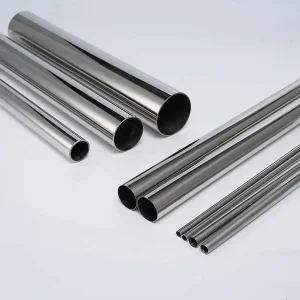
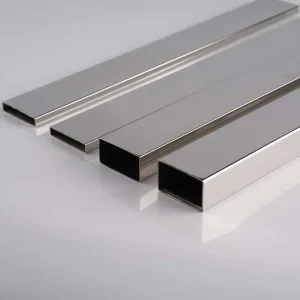
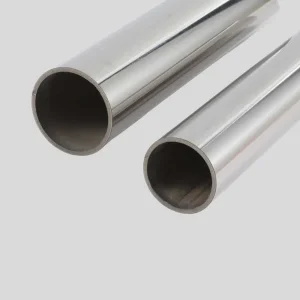
Explore our top-tier stainless steel tubing fittings, CNC machined components, and custom structural profiles manufactured per ASTM A554 and ISO 9001 standards.
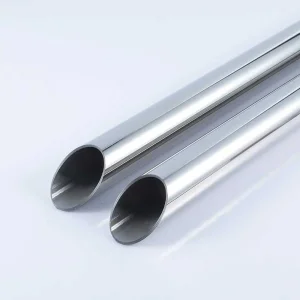
An exhaustive engineering guide evaluating metallurgical selection, manufacturing tolerance controls, and supply chain strategies for industrial procurement directors.
In the contemporary landscape of global industrial manufacturing, selecting top-tier hardware fittings suppliers & factory partners is no longer merely a transaction based on unit price. It has evolved into a strategic engineering decision that directly affects product durability, brand prestige, regulatory compliance, and total cost of ownership (TCO). Hardware fittings—ranging from precision stainless steel structural tubing and decorative architectural balustrades to complex CNC-bent appliance sleeves and high-pressure conveyor roller housings—serve as the mechanical backbone across commercial, residential, and industrial applications.
As search intent analysis reveals, global procurement professionals, architectural fabricators, and Original Equipment Manufacturers (OEMs) demand comprehensive clarity on material chemistry, surface integrity, dimensional tolerances, and production repeatability. The modern global supply chain requires hardware components that comply strictly with international standard specifications such as ASTM A554 (Standard Specification for Welded Stainless Steel Mechanical Tubing), ASTM A249, ASTM A269, JIS G3446, and EN 10217-7.
Information Gain Insight: Standard hardware procurement often suffers from unexpected micro-pitting, weld seam splitting during 90-degree CNC bending, and coating delamination. Partnering with a vertically integrated OEM supplier that manages coil slitting, plasma welding under internal nitrogen shielding, inline eddy current defect detection, and automated PVD surface finishing eliminates over 98% of field failures.
This whitepaper provides procurement directors, industrial designers, and structural engineers with an authoritative roadmap for evaluating high-precision stainless steel hardware fittings, examining the economic advantages of China’s advanced manufacturing hubs, identifying technical industry trends, and establishing rigorous quality assurance protocols.
Why Foshan’s specialized industrial cluster offers unmatched vertical integration, tooling flexibility, and production agility for international buyers.
Located in Foshan (Shishan Town, Nanhai District), China's premier stainless steel industrial nexus, raw strip slitting, plasma welding, annealing, CNC secondary fabrication, and PVD titanium coating occur within a tight 15-kilometer radius. This compresses production lead times to just 15 days.
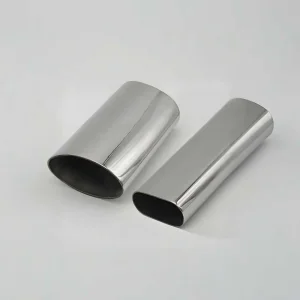
With an existing library of over 500 roll-forming dies—covering round, square, rectangular, flat oval, elliptical, D-shape, and slotted profiles—buyers eliminate massive upfront tooling investments and achieve rapid prototype-to-mass-production cycles.
China factories leverage direct mill-level relationships with global steel giants like TISCO, POSCO, and Baosteel. This guarantees verified chemical heat compositions, consistent grain structure, and complete trace-ability via EN 10204 3.1 Mill Test Certificates.
The concentration of technical talent and specialized machinery in Southern China allows factories to hold outside-diameter (OD) tolerances to ±0.05 mm on precision runs—a level of consistency vital for automated robot assembly lines and friction-fit architectural hardware. Furthermore, by maintaining in-house slitting and continuous roll-forming lines, Chinese manufacturers eliminate external vendor markups, handing global buyers a distinct 18% to 25% cost advantage without sacrificing material integrity.
How automation, advanced surface chemistry, and sustainability are transforming hardware component manufacturing.
Traditional tube welding relied on manual sampling and post-production hydrostatic or flare tests. Contemporary tier-1 factories have integrated online infrared thermal imaging and high-frequency laser scanner systems directly into the roll-forming mill. If a micro-void, gas pocket, or seam offset exceeding 0.02 mm occurs during plasma fusion, the automated mill flags the exact millisecond and marks the section, ensuring zero defective tubing reaches the polishing or packing stage.
Environmental regulations and consumer demand for long-lasting aesthetics have driven a industry-wide migration from electroplating to PVD titanium vacuum deposition. PVD produces a 0.3–0.5 µm super-hard ceramic nitride layer that bonds atomically to the stainless substrate. This provides unmatched UV resistance, scratch resistance, and salt spray immunity in finishes such as Rose Gold, Champagne, Black Titanium, and Antique Brass—outperforming electroplated brass or lacquered iron by over 400% in taber abrasion tests.
Leading global buyers now track Scope 3 carbon emissions. Modern Chinese stainless hardware manufacturers utilize electric arc furnaces (EAF) powered by cleaner energy grids, achieving up to 85% recycled alloy scrap input without degrading mechanical tensile strength (typically ≥ 520 MPa for 304/316L). Furthermore, closed-loop water recovery units in passivation lines ensure zero hazardous chemical runoff into municipal systems.
| Stainless Steel Grade | Nominal Composition | Corrosion Resistance | Tensile / Yield (MPa) | Primary Hardware Applications |
|---|---|---|---|---|
| AISI 201 (High Cu) | 16-18% Cr, 1-1.5% Ni, 5.5-7.5% Mn, Cu added | Moderate (Indoor dry environments) | ≥ 520 / ≥ 275 | Cost-effective indoor furniture legs, wardrobe rods, display racks |
| AISI 304 / 304L | 18-20% Cr, 8-10.5% Ni, < 0.08% C | High (Standard humidity & washdown) | ≥ 515 / ≥ 205 | Sanitary fittings, kitchenware, handles, architectural handrails |
| AISI 316 / 316L | 16-18% Cr, 10-14% Ni, 2-3% Mo | Superior (Chloride & marine coastal) | ≥ 485 / ≥ 170 | Coastal balustrades, outdoor showers, marine hardware, spa equipment |
| Ferritic 409L / 439 | 10.5-11.7% Cr, Ti stabilized, low Ni | Moderate (High thermal resistance) | ≥ 380 / ≥ 175 | Automotive exhaust manifolds, muffler tubes, gas grill burners |
How specialized tubing geometries and custom metallurgical treatments solve critical mechanical challenges across core global markets.
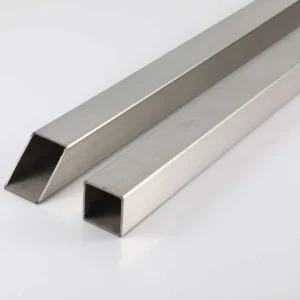
Architectural glass railing systems require high section modulus to resist wind loads and human impact forces. ASTM A554 304/316L square and rectangular tubes with controlled corner radius (sharp corner options with squareness within ±0.5°) ensure rubber gasket seating without gaps, preventing glass panel movement and moisture ingress.
In luxury bathroom hardware (shower arms, slide bars, towel racks), electroplated chrome or PVD finishes easily highlight underlying surface flaws. Substrate tubing undergoes automated multi-pass polishing to achieve surface roughness Ra ≤ 0.4 µm with planished, seamless-look weld beads that eliminate pinholes and blistering.
Unlike plastic-coated lean pipes which peel, crack, and harbor bacteria in food or pharmaceutical environments, solid 304/316L precision round tubing provides an ultra-hygienic washdown solution. Total Indicator Runout (TIR) held under 0.1 mm ensures smooth bearing press-fitting and low-noise roller rotation.
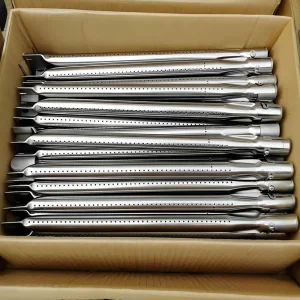
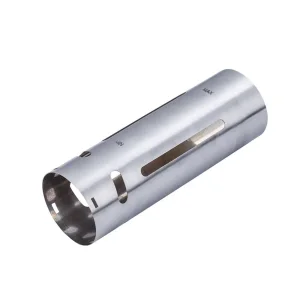
Gas grill burner tubes face intense thermal cycling (up to 700°C) and corrosive fat flare-ups. Custom 304 or 409L tubes feature precise CNC laser-slotted or punched port patterns that guarantee uniform flame propagation while withstanding thermal expansion without seam rupture.
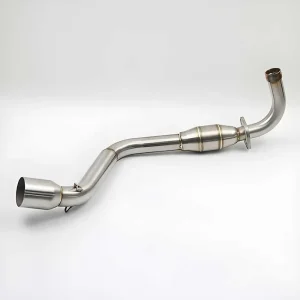
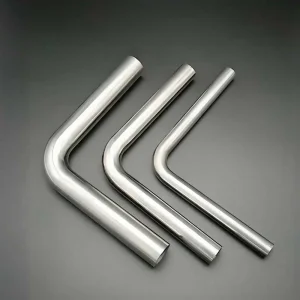
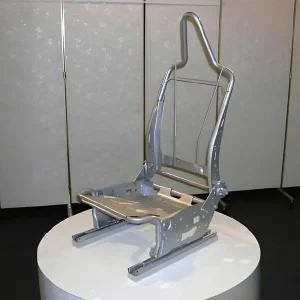
Automotive seat frame structures and exhaust muffler components require exceptional ductility for severe mandrel bending and end flaring. Titanium-stabilized 409L and 304 grade tubing undergo bright annealing to maintain high elongation (≥ 35%) for rupture-free CNC bending.
Hospital bed side rails, IV pole stands, and surgical trolleys demand non-porous surfaces resistant to aggressive quaternary ammonium disinfectants. Precision-welded medical grade 304 tubing eliminates crevices, ensuring full compliance with hospital hygiene protocols.
From preliminary CAD file analysis to automated multi-axis bending and final export sea-freight packaging.
A sophisticated OEM hardware factory operates under strict Quality Assurance (QA) and Quality Control (QC) frameworks. Below is the step-by-step technical workflow executed for custom tube-based hardware components:
Stage 1: DFM Engineering Review & Mold Selection: CAD drawings (STEP/IGES/DWG) are reviewed for wall-thickness-to-diameter ratios and bend radii. Existing roll-forming dies are matched to avoid unnecessary tooling costs.
Stage 2: Precision Slitting & Continuous Plasma Welding: Certified coil stock is slit into exact strip widths. Forming rolls incrementally shape the flat strip into a cylindrical profile, where automatic plasma or TIG welding fuses the joint under internal argon/nitrogen gas purge. This prevents root oxidation (the dreaded "black line" inside the tube bore).
Stage 3: In-Line NDT & Dimensional Calibration: Continuous eddy current sensors detect weld discontinuities at speeds exceeding 40 meters per minute. Mechanical sizing rolls calibrate outside diameter, roundness, and wall uniformity to within ±0.05 mm.
Stage 4: Automated Surface Finishing & CNC Fabrication: Tubes undergo 4-pass abrasive belt grinding to achieve 180#, 240#, 320# satin, or 600# mirror polish. Tubes are then fed into CNC 5-axis rotary benders, laser cutting centers (for slotting, notches, and mounting holes), and end-forming presses (flaring, swaging, necking).
Stage 5: Chemical Passivation & Protective Packaging: Custom hardware pieces are immersed in a nitric-citric acid passivation bath to restore the chromium-oxide passive film. Every individual tube is sleeved in protective plastic wrap, bundled in woven bags, and packed in reinforced steel frames or sea-worthy wooden crates.
Risk mitigation guidelines for Fortune 500 procurement teams, global distributors, and OEM assembly plants.
Never accept generic certificates. Require EN 10204 3.1 documentation for every melt heat number, verifying exact chemical compositions (Cr, Ni, Mo, C, Mn) and mechanical test values (Yield Strength, Tensile Strength, Elongation %, Hardness HRB/HV).
Specify ASTM B117 neutral salt spray testing benchmarks based on deployment environment: 24–48 hours for indoor 201 decorative fittings; 96–168 hours for standard 304 indoor/outdoor hardware; and 500+ hours for marine-grade 316L fittings.
Ensure suppliers guarantee REACH and RoHS 3 chemical safety compliance. For US and EU buyers, work with suppliers experienced in anti-dumping duty classification (HS Code 7306.40/7306.61) to optimize import customs compliance.
Expert answers compiled directly by our senior metallurgical engineers and export logistics team.
Surface rust or "tea-staining" on 304 stainless steel typically stems from two main issues: chloride exposure breaking down the chromium-oxide film, or micro-iron contamination during tooling/polishing. If non-stainless steel tools or uncleaned abrasive belts are used on 304 tubes during fabrication, free iron particles become embedded in the surface. When exposed to air and humidity, these particles oxidize rapidly. To prevent this, our factory uses dedicated stainless-only polishing lines and performs chemical acid passivation (nitric/citric pickling) to remove all surface contaminants and fully restore the passive oxide layer.
Weld seam cracking during CNC mandrel bending usually results from three factors: 1) Insufficient material elongation or work-hardened strip stock; 2) Micro-voids or incomplete fusion in the weld seam; 3) Positioning the weld seam on the outer tension radius during bending. We solve this by supplying bright-annealed bending-grade strip (elongation ≥ 35%), purposed inner nitrogen plasma welding, and instructing operators or CNC tube benders to orient the weld seam at 90 degrees to the bend plane (along the neutral axis).
ASTM A554 is the standard specification for ornamental, structural, and mechanical tubing where dimensional tolerances, surface finish, structural strength, and bendability are paramount. It is the primary specification for hardware fittings, architectural handrails, furniture frames, and appliance tubes. ASTM A269 is intended for general corrosion-resisting and low/high-temperature fluid service, requiring mandatory hydrostatic or non-destructive electric testing and specific heat treatments. While A269 is essential for process piping, A554 is the cost-effective, high-precision choice for structural and decorative hardware.
Our standard MOQ is 500 kg per individual diameter and finish for standard round, square, or rectangular profiles. For custom OEM profiles requiring new roll-forming die development or specialized PVD ceramic colors, the MOQ is typically 1,000 kg (1 metric ton). Production lead time is normally 15 calendar days from artwork/sample approval. Because we maintain over 500 active roll-forming molds in stock, over 80% of custom shape requests require zero new die tooling costs.
Physical Vapor Deposition (PVD) is an eco-friendly vacuum coating process that deposits a thin (0.3–0.5 µm), extremely hard ceramic layer (such as Titanium Nitride or Zirconium Nitride) onto the stainless steel surface. Unlike traditional electroplating—which can blister, peel, and pollute the environment with toxic hexavalent chromium—PVD forms an atomic bond that will not chip or fade under UV light. PVD offers superior scratch resistance (hardness > 2000 HV vs 800 HV for chrome) and passes over 500 hours of neutral salt spray testing.
Yes. Over 60% of our production volume is delivered as ready-to-assemble OEM components. Our in-house secondary processing facilities include CNC precision cut-to-length saws (length tolerance ±0.5 mm), 5-axis tube laser cutters (for intricate slots, holes, and bevels), CNC rotary benders, end-flaring and swaging machinery, press punching, and deburring centers. This allows global clients to receive finished, packaged hardware parts directly onto their production line, cutting out local sub-contracting expenses and reducing scrap waste.
Browse our additional OEM product catalog engineered for automotive, structural, home storage, and handrail applications.