Direct factory manufacturing certified to ASTM A554 standards with precision laser slotting, custom surface finishing, and strict dimensional tolerances.
An authoritative analysis of micro-laser slotting, hydrodynamic flow optimizations, structural load-bearing mechanics, and material science innovations from Foshan's manufacturing ecosystem.
The industrial landscape for slotted and perforated stainless steel pipes has undergone a transformative paradigm shift over the past decade. Driven by rigorous international engineering requirements in subterranean groundwater control, civil infrastructure drainage, environmental remediation, and offshore extraction, China has emerged as the global epicenter for precision tube fabrication. Modern industrial projects no longer tolerate traditional mechanical punching methods that introduce micro-cracks, residual stress concentration zones, and erratic slot tolerances. Instead, premier tier-1 Chinese manufacturers rely on multi-axis CNC fiber laser systems, inert gas shielded plasma welding, and precision cold roll-forming lines to manufacture slotted and perforated piping systems designed to withstand extreme hydrostatic and mechanical loads.
Slotted and perforated pipes function as specialized fluid control conduits. Their structural efficacy depends entirely on balancing two competing engineering parameters: hydraulic open area percentage (which dictates fluid inlet velocity and pressure drop) and structural collapse resistance (which determines depth capacity and overburden tolerance under geomechanical strain). Utilizing premium austenitic grades such as AISI 304, 304L, 316, and 316L, alongside high-yield Duplex alloys (UNS S31803 / S32205), leading Chinese factories provide customized open area ratios ranging from 3.5% to upwards of 18%, keeping micro-slot width tolerances controlled within an incredible ±0.02 mm limit.
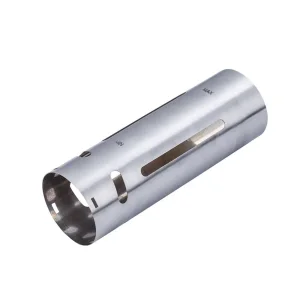
CNC laser cut slots ranging from 0.15mm to 3.0mm width eliminate burrs, reduce heat-affected zones (HAZ), and maintain baseline material ductility.
Calculated slot configurations minimize entrance head loss, drastically reducing particle velocity to prevent localized bio-fouling and sand bridging.
Full-body pickling and passivation treatments restore the chromium-oxide passive film across both outer diameter surfaces and internal slot edges.
Operational data representing production performance, technical testing metrics, and delivery capabilities for international procurement groups.
Understanding the interplay between grain size distribution ($D_{10}$, $D_{60}$), slot width selection, mechanical yield strength, and structural collapse pressure.
Global EPC contractors, municipal engineers, and mine operators face distinct mechanical challenges when specifying slotted and perforated stainless steel tubing. Selecting the correct slotted pipe parameters requires a clear mathematical evaluation of the geological or fluid media environment. For instance, in groundwater abstraction wells or mining tailing dewatering projects, selecting a slot size that is too wide leads to severe sand ingress, pump impeller erosion, and eventual well collapse. Conversely, choosing a slot size that is too narrow restricts flow rate, elevates drawdown head loss, and accelerates scale precipitation.
| Application Sector | Recommended Alloys | Slot/Perforation Style | Slot Width / Dia Range | Open Area % | Key Performance Target |
|---|---|---|---|---|---|
| Oil & Gas Sand Control | AISI 316L / 2205 Duplex | Keystone / Cut-Laser Slot | 0.15 mm – 0.50 mm | 4.0% – 8.5% | High collapse strength, erosion resistance |
| Deep Groundwater Wells | AISI 304 / 304L / 316L | Continuous Bridge / Straight Slot | 0.50 mm – 2.00 mm | 8.0% – 15.0% | Low entrance velocity (<0.03 m/s), anti-scaling |
| Mining Leachate Drainage | AISI 316L / 317L / 904L | Staggered Round Perforated | 3.00 mm – 12.00 mm | 12.0% – 22.0% | Acidic slurry immunity (pH 1.5–4.0), high radial stiffness |
| Civil Slope Dewatering | AISI 304 / ASTM A554 | Longitudinal Slotted | 1.00 mm – 3.00 mm | 6.0% – 10.0% | Tensile bending yield during ground movement |
| Architectural & Acoustic | AISI 201 / 304 Decorative | Micro-Perforated Grid | 0.80 mm – 2.50 mm | 15.0% – 35.0% | Aesthetic uniform finish, PVD color compatibility |
When procuring from Chinese factories, engineering buyers must evaluate the Mill Test Certificate (MTC) to verify compliance with EN 10204 3.1. Chemical composition—specifically Carbon (≤0.030% for L-grades), Chromium (≥17.5% for 304), Molybdenum (≥2.0% for 316), and Nitrogen content—must be strictly audited. Furthermore, mechanical testing must validate yield strength ($R_{p0.2}$), tensile strength ($R_m$), and minimum elongation ($A_5$) values after laser cutting or punching operations have taken place, ensuring structural integrity is preserved.
Turnkey engineered configurations utilizing slotted stainless steel pipes for severe environmental, structural, and industrial environments.
Landfill containment sites generate highly toxic, acidic leachate rich in chlorides and organic solvents. Standard PVC or HDPE perforated pipes frequently buckle under immense overburden pressure or degrade due to chemical attack. Heavy-wall slotted 316L stainless steel pipes offer the load capacity required for deep fill applications alongside total resistance to environmental stress cracking.
Highways, tunnel portals, and heavy civil foundations constructed on unstable clay slopes require horizontal relief wells to prevent catastrophic pore-water pressure buildup. Slotted stainless steel casing tubes provide high tensile resistance to shear stresses caused by localized land movement while continuously discharging sub-surface water.
Chemical processing plants, breweries, and water treatment utilities utilize custom perforated filter cores inside high-pressure filter vessels. Slotted 304 and 316L tubes serve as rigid internal elements supporting fine wire mesh or filter cloths, enduring differential pressures ($\Delta P$) up to 25 bar without mechanical deformation.
In-depth examination of thermal laser dynamics, edge squareness, nitrogen purge shielding, and anti-clogging slot geometry designs.
The transition from mechanical punch presses to fiber laser slotting represents a dramatic technological leap forward. Mechanical punching inherently creates structural micro-fractures along perforation edges, severely compromising fatigue strength. Furthermore, tool wear during mechanical punch runs leads to progressive burr formation, which restricts fluid flow and encourages particulate nucleation. CNC Fiber Laser systems resolve these vulnerabilities through a combination of high-density photon energy and high-pressure nitrogen gas assist.
In high-solids fluid filtration (such as oil sands extraction, geothermal wells, or coarse groundwater aquifers), slot geometry governs anti-clogging longevity. Chinese factories specialize in two primary laser-cut profile geometries:
During the laser cutting process, an inert purge of 99.999% pure Nitrogen ($N_2$) is injected through the cutting nozzle. This displaces atmospheric oxygen, preventing thermal oxidation (scale formation) on the cut edges. Consequently, the pristine metallic lattice of the stainless steel alloy remains exposed and chemically receptive to post-fabrication pickling baths, ensuring full passive layer recovery.
Comprehensive protocol verification for international supply chain security, non-destructive testing (NDT), and structural compliance.
To eliminate procurement risks for international buyers, leading Chinese suppliers enforce a stringent multi-tier quality management system (QMS) compliant with ISO 9001:2015 and international manufacturing codes such as ASTM A554 (Ornamental/Structural Welded Tubing), ASTM A312 (Seamless and Welded Austenitic Stainless Steel Pipe), and ASTM A249 (Welded Boiler/Heat-Exchanger Tubes).
Anticipating the next era of smart perforated tubing, sensor integration, circular green metallurgy, and AI-optimized slot configurations.
As industrial automation, smart infrastructure monitoring, and environmental sustainability become paramount, Chinese manufacturers are pioneering cutting-edge developments in slotted pipe technology:
Specialized solutions for marine, sanitary, medical, home equipment, and high-precision mechanical structural applications.
Expert answers addressing alloy selection, slot geometry, minimum order quantities, and custom fabrication services.
For standard freshwater aquifers or civil dewatering projects with neutral soil chemistry, AISI 304 / 304L provides excellent structural strength and cost-efficiency. However, in saline environments, coastal locations, or landfill leachate applications containing high chloride levels, AISI 316L (with 2.0-3.0% Molybdenum) is mandatory to prevent pitting and crevice corrosion. For extreme depths or acidic mining runoff, 2205 Duplex stainless steel delivers double the yield strength of austenitic grades while providing superior resistance to stress corrosion cracking (SCC).
Laser slotting utilizes a non-contact CNC process guided by fiber optics, which generates zero mechanical stress or cold-work hardening around slot apertures. This maintains the native ductility of the stainless steel tube. Additionally, laser technology allows micro-slot widths down to 0.15 mm with tolerances of ±0.02 mm, whereas mechanical punching is limited to larger hole diameters (≥1.5 mm) and creates micro-cracks that serve as initiation sites for corrosion and fatigue failure under cyclic pressure loading.
Optimal open area is determined by balancing fluid flow velocity against pipe collapse resistance. According to standard hydrodynamic guidelines, fluid entrance velocity through the slots should not exceed 0.03 m/s (0.1 ft/s) to minimize head loss and prevent fine sand movement. The formula for open area percentage ($AO\%$) is:
AO% = [ (Slot Width × Slot Length × Number of Slots per Meter) / (π × Outer Diameter × 1000) ] × 100
Our engineering team assists customers in matching slot patterns directly to sieve analysis data ($D_{10}, D_{60}$ grain sizes) provided from site core samples.
Yes. In addition to precision slotting and perforating, our Foshan factory houses comprehensive secondary CNC machining lines. We offer male/female Flush Joint API threading, standard NPT or BSP pipe threads, welded ISO/DIN flanges, end flaring, necking, laser hole punching, and custom CNC mandrel bending. Buyers receive fully processed, installation-ready components directly at site.
Every shipment is backed by a full compliance documentation package, including the original Mill Test Certificate (MTC) conforming to EN 10204 3.1 detailing heat number chemical analysis and mechanical tensile test results. Upon request, we also furnish third-party inspection reports (SGS, BV, or TÜV), dimensional inspection logs, 500-hour neutral salt spray certificates, and Certificate of Origin (Form E, Form F, or CO) documentation for customs clearance.
For standard stainless steel tube diameters (OD 12.7 mm to 219.1 mm) in 304 or 316L, our baseline MOQ is 500 kg per size. Custom profile tooling or specialized PVD color coatings require an MOQ of 1,000 kg. Standard manufacturing lead time is 15 to 20 days following sample and technical drawing sign-off. Accelerated 10-day lead times are available for urgent project replacements utilizing our in-stock prime coil inventory.