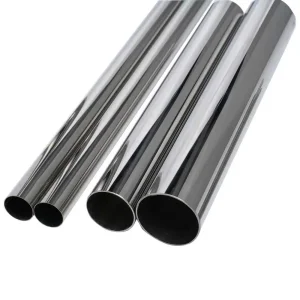
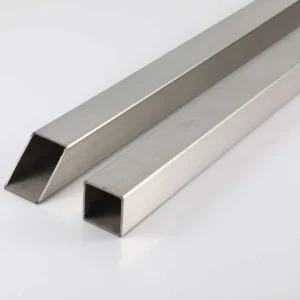
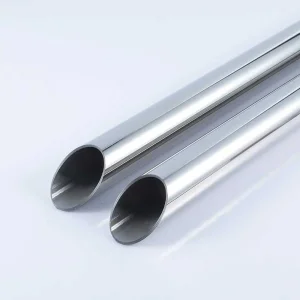
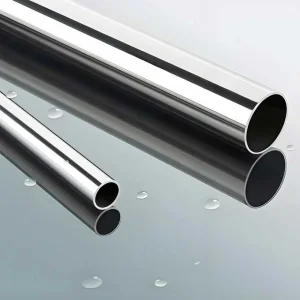
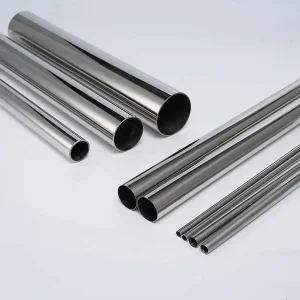
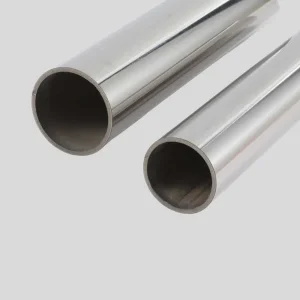
Explore our primary ASTM-certified stainless steel profiles engineered for high-durability decorative, architectural, automotive, and industrial applications.
An authoritative analysis of substrate stainless steel selection, plasma arc vacuum evaporation, color space spectrometry, and interfacial bond integrity.
In modern industrial design, structural engineering, and luxury architecture, Champagne Gold Stainless Steel Tubing represents the apex where metallic strength meets high-end aesthetics. Unlike legacy chemical wet-electroplating or organic powder coating methods—which suffer from micro-delamination, environmental toxicity, and poor wear resistance—modern industrial manufacturing utilizes Physical Vapor Deposition (PVD) Titanium Nitride (TiN / TiCN / ZrN) multi-layer arc evaporation technology under deep vacuum conditions.
The mechanical performance and corrosion resilience of champagne gold tubing depend fundamentally on the chemical composition of the underlying stainless steel substrate coil. As a premier China manufacturer based in Foshan, our production facility mandates prime virgin coil stock sourced exclusively from TISCO, POSCO, and Baosteel. We enforce strict heat-analysis controls across five key alloy grades:
Achieving the precise, elegant hue of Champagne Gold requires sophisticated vacuum chamber thermodynamics. Raw, polished tubes undergo a rigorous 9-stage ultrasonic solvent degreasing and deionized water rinsing cascade to eliminate all hydrocarbon residues and iron contaminants. The tubing is then loaded into a high-vacuum chamber pumped down to base pressures of $10^{-3} \text{ Pa} \ (10^{-5} \text{ Torr})$.
Inside the chamber, high-purity Titanium (99.99% Ti) and Zirconium (99.9% Zr) target cathodes are vaporized using cathodic arc evaporation. Reactive gases—specifically Nitrogen ($N_2$), Acetylene ($C_2H_2$), and Argon ($Ar$)—are metered via mass flow controllers at elevated substrate temperatures ($250^\circ\text{C}$ to $400^\circ\text{C}$). The resulting plasma condenses onto the stainless steel tube surface, synthesizing a ultra-hard stoichiometric thin film (thickness: 0.3 \mu m \text{ to } 0.6 \mu m).
Color consistency across multi-ton production runs is the single greatest challenge in decorative tube manufacturing. Our factory eliminates visual variance by utilizing handheld spectrophotometers calibrated to the CIE $L^*a^*b^*$ color space system:
By enforcing a total color difference tolerance of $\Delta E_{ab}^* < 0.5$ between manufacturing master samples and production heats, we guarantee absolute color uniformity for large-scale architectural projects where adjacent tubes must match seamlessly under ambient lighting.
How international B2B buyers, EPC contractors, and OEM fabricators optimize total cost of ownership (TCO) and mitigate supply chain vulnerabilities when sourcing from China.
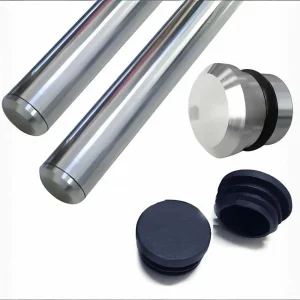
Preventing transport scuffs and fabrication scratches is critical. We apply 80 to 100-micron co-extruded PE protective films, specialized laser-cutting compatible films, and end-cap plugs to guarantee pristine arrival.
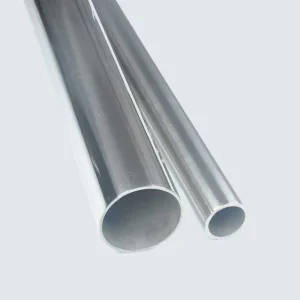
Automated high-end bending equipment demands strict outer diameter (OD) and wall thickness (WT) consistency. Our laser micrometer lines enforce OD tolerances within ±0.05 mm and ovality under 1.0%.
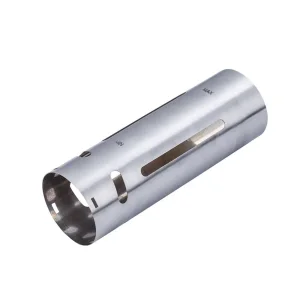
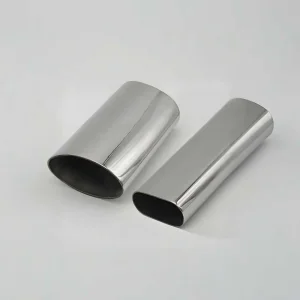
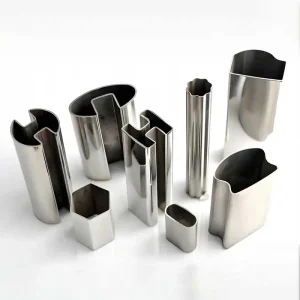
Avoid expensive die-casting costs. Fabricators gain instant access to over 500 existing roll-forming moulds for flat oval, elliptical, triangular, capsule, and single/double slotted tubing profiles.
Every shipment is accompanied by complete chemical heat analysis, mechanical tensile/yield testing, flattening/flaring test results, and eddy-current non-destructive testing reports.
Containerized cargo requires anti-humidity protection. Tubes are individually wrapped in plastic sleeves, bundled into waterproof woven bags, and secured in fumigated wooden cases or reinforced steel frames.
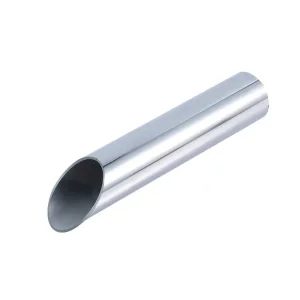
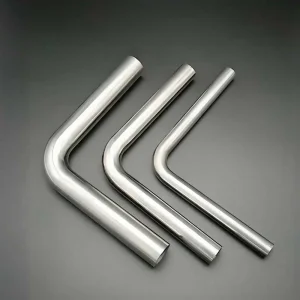
Reduce local labor costs by leveraging our in-house secondary processing: CNC laser slotting, precision rotary draw bending, end flaring, necking, hole punching, and deburring.
Technical parameters, dimensional capabilities, standard compliance, and surface finish metrics for high-precision champagne gold stainless steel tubing.
| Specification Parameter | Decorative / Architectural (ASTM A554) | Sanitary / Hardware (ASTM A270/A249) | Structural / Automotive (ASTM A554 / 409L) |
|---|---|---|---|
| Available Outer Diameter (OD) | Round: 6.0 mm – 219.1 mm | Round: 9.5 mm – 101.6 mm | Round: 12.7 mm – 168.3 mm |
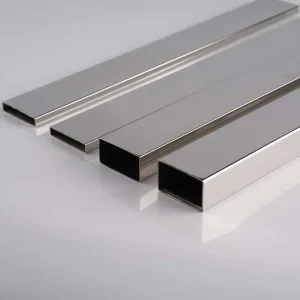
| Square & Rectangular Sections | 10×10 mm to 150×150 mm | 15×15 mm to 80×80 mm | 20×20 mm to 120×120 mm |
| Wall Thickness (WT) Range | 0.4 mm – 4.0 mm (±8% tolerance) | 0.6 mm – 2.5 mm (±5% precision) | 0.8 mm – 3.5 mm (±7.5% tolerance) |
| Substrate Alloy Options | AISI 201, 304, 304L, 316, 316L | AISI 304, 316L (Low Carbon) | AISI 304, 409L, 439, 441 |
| Mechanical Polishing Base | 180# Satin, 320# Hairline, 600# Mirror | Internal Ra ≤ 0.4 μm, Mirror 800# | 240# Satin, Mill Finish / Pickled |
| PVD Coating Hardness | 2000 HV – 2500 HV (TiN/ZrN) | 2200 HV – 2600 HV (TiCN) | 1800 HV – 2200 HV (TiN) |
| Corrosion Resistance (NSS) | 304 PVD: >500 Hours Neutral Salt Spray | 316L PVD: >1000 Hours Neutral Salt Spray | 409L: Passivation Treated |
| Fabrication Workability | Rotary draw bending, 90° mitering | Flaring, necking, orbital welding | Hydroforming, press flattening |
When engineering structural assemblies with champagne gold PVD tubing, specific fabrication protocols must be observed to maintain both the cosmetic integrity of the ceramic titanium coating and the structural stability of the weld seam:
During rotary draw bending or mandrel bending, the tube undergoes significant tensile stress along the outer radius (extrados) and compressive stress along the inner radius (intrados). To prevent micro-cracking of the PVD film or seam splitting:
Conventional TIG welding burns away the micro-thin PVD titanium film within the heat-affected zone. For seamless architectural joining:
Deploying high-performance colored stainless steel tubing across international markets while maintaining alignment with global building codes and environmental directives.
Widely specified in Dubai, Riyadh, and Doha for flagship hotel lobbies, curtain wall fins, and grand balustrades. Materials pass extreme thermal cycle testing ($+55^\circ\text{C}$ ambient) and dust-abrasion resistance checks.
Utilized by premium fashion brands and commercial interiors across NYC, Los Angeles, and Toronto for garment display systems, entrance portals, and perimeter architectural trim adhering to ASTM A554 standards.
Fully compliant with EU REACH (EC 1907/2006) and RoHS (Directive 2011/65/EU) regulations. PVD dry vacuum deposition eliminates hexavalent chromium ($Cr^{VI}$) and heavy metal effluents completely.
Expert technical clarity provided by our metallurgists, quality control managers, and international trade specialists.
Partner with China's leading precision stainless steel tubing manufacturer. Contact our metallurgical engineering team today for technical consultation, CAD profile verification, and competitive mill-direct pricing.
Explore our extended manufacturing capability covering medical, sanitary, conveyor, mechanical, and custom CNC fabricated tubing products.