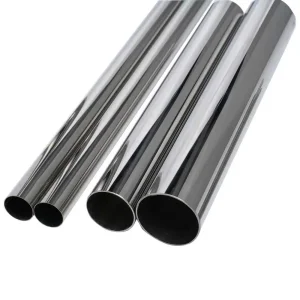
Direct mill supply of welded round, square, rectangular, and oval stainless steel tubing tailored for structural, automotive, sanitary, and decorative engineering.
Analyzing shifting global procurement dynamics, surface roughness parameters, and ASTM specifications governing modern architectural and mechanical stainless steel tube manufacturing.
The global demand for polished 304 stainless steel tubing has undergone a paradigm shift over the past decade. Driven by modern architectural aesthetics, stringent sanitary regulations, and high-performance automotive structural requirements, global original equipment manufacturers (OEMs) and engineering, procurement, and construction (EPC) contractors require far more than basic structural round tubes. Sourcing strategy is now focused on precise surface roughness ($Ra$) control, microstructural weld integrity, consistent grain orientation, and tight dimensional tolerances to prevent down-stream production bottlenecks during CNC mandrel bending, laser slotting, and hydroforming processes.
Austenitic stainless steel grade 304 (UNS S30400 / EN 1.4301), containing a nominal composition of 18% chromium and 8% nickel, remains the cornerstone metal alloy for decorative and semi-structural applications. The inherent corrosion resistance of Grade 304 relies entirely on the rapid formation of a passive, self-healing chromium oxide ($\text{Cr}_2\text{O}_3$) film. However, mechanical polishing—ranging from standard 180-grit satin brushing to 600-grit mirror finishes—can alter the surface topology and micro-strains of the steel. Top-tier China polished 304 stainless steel tubing suppliers have integrated multi-stage automated polishing lines operating under controlled temperature and chemical conditions to preserve passive surface stability while meeting strict mirror reflectivity indices.
Advanced multi-pass abrasive belting achieves $Ra \le 0.2\,\mu\text{m}$ ($8\,\mu\text{in}$) for high-mirror finishes, preventing bacterial adhesion in sanitary systems and ensuring flawless substrate electroplating for sanitary fittings.
In-line weld bead rolling (planishing) flattens internal and external weld seams under heavy hydraulic pressure. This eliminates internal crevices and stress risers, essential for downstream high-radius tube bending.
High-purity argon/nitrogen purge gas during continuous TIG or laser welding prevents bore-side oxidation ("sugar buildup"), maintaining 100% metallurgical corrosion resistance across the heat-affected zone (HAZ).
Understanding standard governance is critical for B2B engineering procurement. While ASTM A554 specifies ornamental, structural, and mechanical welded tubing where surface aesthetics and dimensional precision dominate, applications involving pressure containment, heat exchangers, or sanitary fluid transportation necessitate compliance with ASTM A249 / ASTM A269. Leading Foshan manufacturers offer dual-certified stock and custom production runs to suit exact mechanical load and pressure metrics.
How international buyers in North America, Europe, Southeast Asia, and the Middle East evaluate total cost of ownership (TCO) when sourcing polished stainless steel tubing from China.
Procurement directors and supply chain managers in tier-1 manufacturing hubs face complex trade-offs when ordering stainless steel tubing. Major industrial pain points encountered in global supply chains include dimensional drift in wall thickness, micro-cracking during CNC mandrel bending, uneven polish reflectivity, and micro-pitting caused by poor post-welding surface passivation. When importing polished 304 stainless steel tubing from China suppliers, overcoming these vulnerabilities requires robust quality management protocols, traceable material test certificates (MTCs), and strict raw material verification.
Modern engineering projects demand comprehensive technical validation. Standard mill test reports must comply with EN 10204 3.1 standards, detailing exact chemical heat analysis (carbon, manganese, phosphorus, sulfur, silicon, chromium, and nickel content) alongside mechanical test parameters (yield strength $R_{p0.2}$, tensile strength $R_m$, percentage elongation $A$, and Rockwell hardness HRB). China's leading mills utilize direct-reading optical emission spectrometers (OES) to guarantee raw coil chemistry prior to longitudinal slitting.
| Evaluation Parameter | Standard Market Supply | Top-Tier China Mill (VertexFlow Standard) | Impact on OEM Fabrication |
|---|---|---|---|
| Raw Material Source | Secondary / Re-melted Stainless Scrap Coil | 100% Prime Strip (TISCO, POSCO, Baosteel) | Prevents inclusions, delamination, & stress cracking. |
| OD & Wall Tolerance | OD $\pm 0.20\,\text{mm}$, Wall $\pm 12\%$ | OD $\pm 0.05\,\text{mm}$, Wall $\pm 5\%$ | Ensures perfect seating in robotic welding jigs. |
| Weld Seam Integrity | Basic High-Frequency / Unshielded TIG | Plasma/Laser Welded + Inner Nitrogen Purge | Eliminates bore oxidation & seam splitting on $90^\circ$ bends. |
| Polishing Quality | Manual single-pass 240# or 400# finish | Automated 4-pass 600# Mirror & PVD Coatable | Uniform gloss retention, zero polishing haze, high corrosion resistance. |
| Salt Spray Performance | Neutral Salt Spray (NSS) < 96 Hours | Passivated 304: NSS > 240h; 316L: NSS > 500h | Prevents tea-staining in humid or coastal environments. |
Inside the world’s most concentrated stainless steel industrial hub: How vertical integration, 43 automated production lines, and smart manufacturing drive unparalleled lead times and cost efficiency.
Foshan, Guangdong Province, stands as the global nerve center for stainless steel tube fabrication and surface finishing. By concentrating cold-rolling mills, precision slitting facilities, roll-forming line manufacturers, chemical passivation plants, and polishing specialists within a 30-kilometer radius, Foshan-based factories achieve unmatched operational synergy. This industrial ecosystem minimizes inter-process freight costs, eliminates raw material buffering delays, and provides instant access to custom tooling for non-standard geometric profiles.
The transformation toward Industry 4.0 has upgraded traditional tube mills into smart, data-driven manufacturing plants. Automated inline eddy current testing (ECT) systems continually scan weld seams for sub-surface discontinuities at line speeds exceeding 25 meters per minute. Laser micrometer gauges log continuous outer diameter (OD) and ovality metrics, instantly adjusting sizing rolls via closed-loop feedback systems to maintain tolerances within $\pm 0.05\,\text{mm}$.
From high-end interior architecture to heavy industrial conveyancing: Practical engineering implementations of 304 polished tubing across global industries.
ASTM A554 round and square tubes with 320-grit satin or 600-grit mirror finishes. Enhanced resistance to atmospheric corrosion makes 304/316 grade tubing the benchmark for safety railings, airport terminals, and shopping mall glass balustrades.
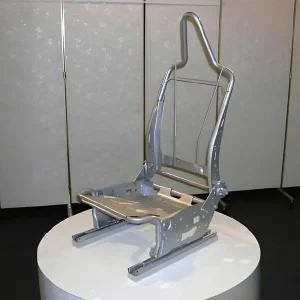
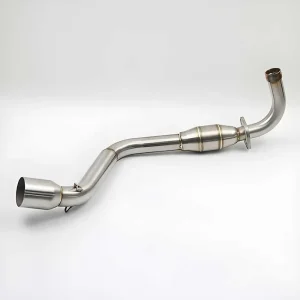
Formed round and custom oval tubing designed to withstand vibration fatigue, cyclic thermal expansion, and road-salt splash. 304 and 409L grades are hydroformed into intricate manifold piping and rigid bus chassis frames.
Sanitary precision tubes boasting ultra-smooth internal surfaces ($Ra \le 0.4\,\mu\text{m}$) and pinhole-free weld seams. These serve as high-adhesion bases for modern PVD (Physical Vapor Deposition) gold, rose gold, and matte black brass coating replacements.
Low total indicator runout (TIR) stainless tubing engineered for high-speed conveyor shells. Replaces painted carbon steel in pharmaceutical cleanrooms and food processing flow racks to prevent flaking paint and corrosion wash-down hazards.
Heavy-wall structural 304 tube engineered for maximum tensile load-bearing capacity without bending deflection. Supplied with knurled, textured satin, or high-polish anti-bacterial surfaces for hospital and residential eldercare installations.
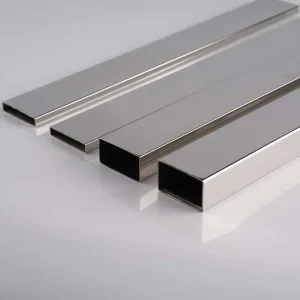
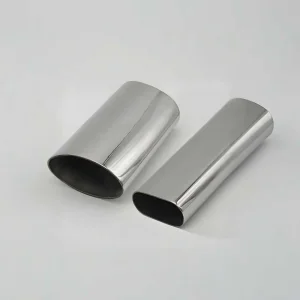
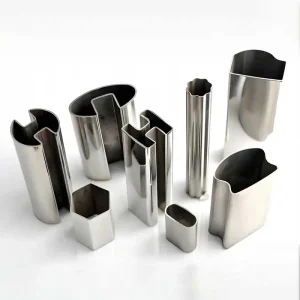
Special profile tubing—including flat oval, D-shape, triangle, and double-radius channel sections—providing interior designers with sleek metallic geometry, light weight, and structural strength for high-end furniture structures.
Explore specialized industrial tubing solutions, custom CNC fabricated profiles, hardware components, and heavy-duty structural sections.
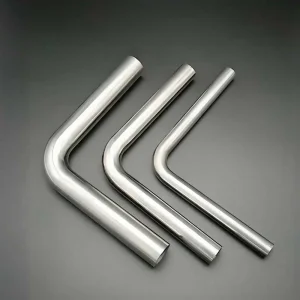
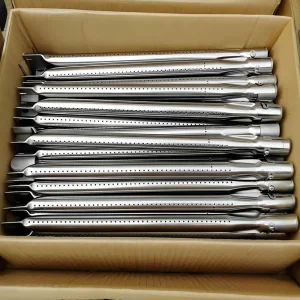
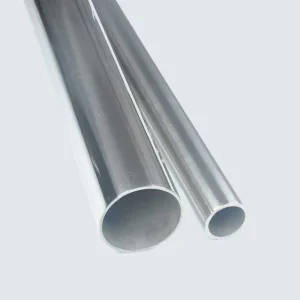
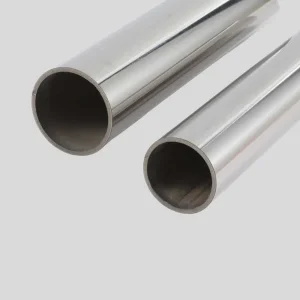
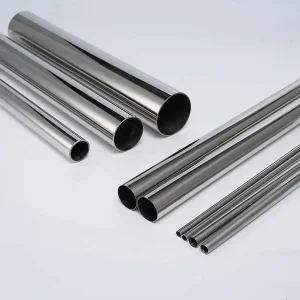
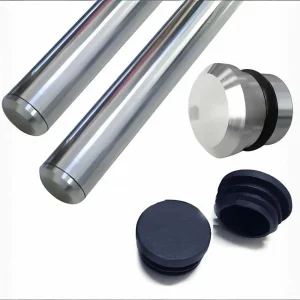
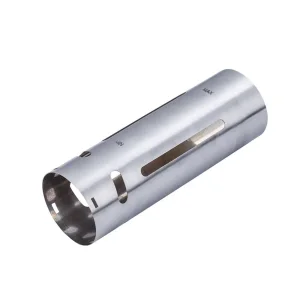
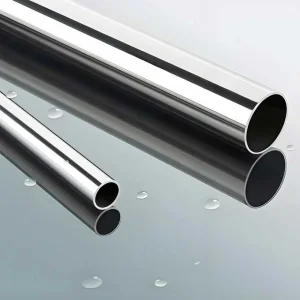
Eliminate intermediate processing steps and reduce scrap costs by receiving pre-cut, CNC-bent, laser-slotted, and color-finished assembly-ready components.
Modern global buyers increasingly move away from importing standard 6-meter raw mill lengths due to container space inefficiency, scrap generation, and localized labor costs. Top-tier China manufacturers provide comprehensive secondary tube fabrication services under one roof. By integrating 5-axis CNC laser cutting machines, multi-radius rotary draw mandrel benders, end-flaring/necking systems, and automated deburring cells, factories deliver components that transition directly to final assembly lines.
Achieve complex inter-pipe joints, saddle notches, bevel cuts, and structural mounting slots with beam positioning accuracy of $\pm 0.03\,\text{mm}$. Eliminates manual drilling and grinding entirely.
Tight centerline radius ($CLR \ge 1.5 \times OD$) bending without tube flattening, wall thinning, or wrinkling. Controlled weld seam positioning prevents seam splitting during severe plastic deformation.
Physical Vapor Deposition applies a micro-thin (0.3–0.5 $\mu\text{m}$) ceramic layer of Titanium Nitride (TiN). Available in Champagne Gold, Rose Gold, Black Titanium, Gunmetal, and Bronze with superior UV and scratch resistance.
Authoritative answers compiled by metallurgy specialists and export quality assurance engineers to address common procurement and manufacturing queries.
We manufacture precision welded tubing in austenitic grades 201 (high copper), 304, 304L, 316, and 316L, alongside ferritic grades such as 409L and 439. Dimensions adhere strictly to ASTM A554 (ornamental/structural), ASTM A269 (general service), ASTM A249 (boiler/condenser), EN 10217-7, and JIS G3446. Mill test certificates (EN 10204 3.1) accompanying every shipment detail chemical heat numbers and mechanical test data.
Standard outside diameter (OD) tolerance is $\pm 0.10\,\text{mm}$, with high-precision runs tightened to $\pm 0.05\,\text{mm}$ for application substrates like conveyor rollers and electroplating tubes. Wall thickness tolerance is held within $\pm 5\%$ to $\pm 8\%$, straightness is maintained at $\le 1.0\,\text{mm/m}$, and corner squareness on square/rectangular sections is held to within $\pm 0.5^\circ$. All metrics are verified inline using non-contact laser telemetry.
Superficial tea-staining occurs when airborne chloride ions break down the passive chromium oxide film on 304 stainless steel in marine or high-humidity coastal settings ($< 5\,\text{km}$ from seawater). For these environments, Grade 316L—containing 2.0–3.0% Molybdenum—is mandatory to withstand pitting corrosion. Furthermore, picking and passivating weld seams removes micro-particles of free iron deposited during forming, dramatically raising salt spray performance past 500 hours.
Bending failures are typically caused by work-hardened raw material, un-planished inner weld beads, or placing the weld seam along the outer tension radius during bending. We prevent this by selecting deep-drawing quality strip with high elongation ($A \ge 45\%$), planishing weld seams flat, and utilizing inline bright annealing at $1050^\circ\text{C}$ to fully stress-relieve the crystal lattice prior to bending.
Standard factory MOQ is 500 kg per size and finish for standard round and square profiles, and 1,000 kg for custom profiles or specialized PVD colors. Because our library contains over 500 active roll-forming die sets, most custom shapes require zero tooling costs. Standard manufacturing lead time is 15 business days following sample sign-off and deposit receipt.
Mirror and highly polished tubes are individually wrapped in PE protective film or woven plastic sleeves. Bundle lots are wrapped in waterproof PE shrink film, reinforced with corrugated plastic edge covers, and secured in wooden crates or heavy-duty steel frames. This multi-layer barrier guards against abrasion, condensation corrosion, and physical impact during long transit cycles.