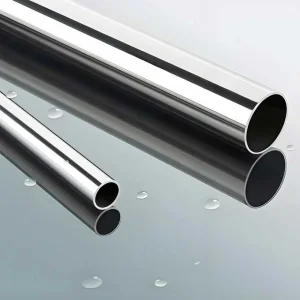
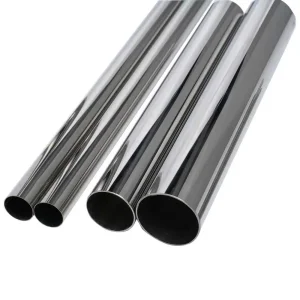
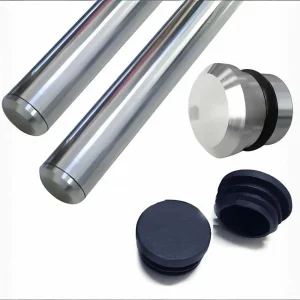
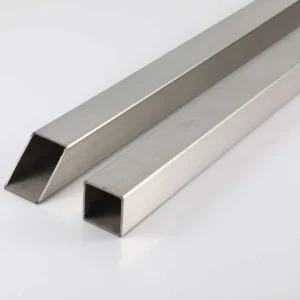
Explore our core engineering tube series manufactured under strict ASTM A554/A249 dimensional parameters.
An exhaustive analysis of work hardening, moment of inertia augmentation, and anti-friction surface dynamics in modern industrial piping.
In structural and decorative fluid dynamics, 1.5 mm nominal thickness (16 Gauge / ~0.059 inches) represents the precise boundary where flexural rigidity matches light-weight processing efficiency. Standard smooth-walled tubing at 1.5 mm frequently suffers from localized buckling under point-load stress and aesthetic marring due to ambient micro-scratches.
By subjecting austenitic stainless steel (such as 304, 304L, and 316L) or high-copper 201 alloys to precision cold-roll mechanical embossing, the parent metal undergoes localized plastic deformation. This process rearranges the grain structure and generates a work-hardening effect, elevating yield strength by up to 28% without increasing material volume.
Embossing creates three-dimensional repeating patterns (e.g., diamond knurling, leather grain, stippled dots, or custom architectural fluting) that displace metal away from the neutral axis. This micro-geometrical distribution increases the section modulus and second moment of area (I).
Furthermore, the embossed topography alters surface contact points. In fluid or tactile interaction, it decreases optical fingerprint reflection, increases tactile grip friction (critical for safety grab bars and industrial railings), and distributes external mechanical impacts across a network of micro-ribs.
Comprehensive empirical lab testing demonstrates that a 1.5 mm embossed tube achieves flexural performance equivalent to a 1.8 mm smooth tube while cutting total shipment weight by 16.6%. This yields significant freight savings and structural material optimization for large-scale engineering contracts.
| Mechanical Property / Parameter | Standard Smooth Pipe (1.5mm) | ODM Embossed Pipe (1.5mm) | Engineering Advantage |
|---|---|---|---|
| Yield Strength (Rp0.2) | 230 - 260 MPa | 295 - 340 MPa | +28% Work-hardened load capacity |
| Bending Resistance (Deflection) | Baseline (1.0x) | Enhanced (1.35x) | 35% lower deflection under central load |
| Surface Hardness (Vickers HV) | 170 - 190 HV | 210 - 240 HV | Superior scratch & abrasion resistance |
| Tactile Friction Coefficient | μ = 0.25 (Smooth) | μ = 0.58 (Textured) | Anti-slip safety compliance (ADA grade) |
| Thermal Radiation Area | 100% Surface Footprint | 118% Nominal Area | +18% efficiency in heat dissipation |
How international regulatory standards and architectural shifts are accelerating adoption of 1.5mm embossed tubular profiles.
Global municipal infrastructure project managers in North America, Western Europe, and East Asia are phasing out plain painted or polished tubing in public transit systems. High-traffic environments—such as metro handrails, airport luggage cart frames, and bus stop enclosures—demand material that conceals scratch wear and resists graffitists. The 1.5mm embossed profile delivers long-lasting durability, cutting city maintenance budgets by up to 40%.
Industrial heating and cooling manufacturers are increasingly specifying inner/outer embossed 1.5mm tubing for condensors, boilers, and heat exchangers. The micro-embossed textured wall disrupts boundary layer thermal insulation, inducing micro-turbulences in fluid or air flow. This significantly enhances heat exchange efficiency without incurring the pressure drop penalties associated with heavy internal fins.
Post-pandemic healthcare facility upgrades require specialized grab rails, hospital bed frames, and rehabilitation balance bars. The 1.5mm wall provides robust mechanical anchoring for wall brackets, while anti-microbial textured finishes combined with PVD (Physical Vapor Deposition) gold or gunmetal titanium coatings provide visual elegance alongside slip-resistant patient safety.
How Foshan's premier industrial ecosystem delivers unmatched lead times, dimensional tolerances, and ODM versatility.
Our Foshan manufacturing matrix integrates coil slitting, high-frequency plasma/TIG welding, inner-seam leveling, online bright annealing, roll embossing, and automatic cutting into a continuous workflow.
By purchasing prime stainless coils directly from top-tier mills (TISCO, POSCO, Baosteel), every heat is accompanied by verifiable EN 10204 3.1 Mill Test Certificates (MTC), establishing total chemistry and mechanical property traceability for OEM buyers.
Defects in embossed piping are difficult to spot manually because surface patterns can mask weld micro-cracks. Our Industry 4.0 production lines solve this issue using non-destructive online eddy-current testing combined with multi-axis laser sensors.
Every single millimeter of the weld seam is scanned at high temperatures before forming. If a pinhole or gas cavity exceeds strict quality thresholds, the line automatically flags and cuts the affected section, guaranteeing 100% weld integrity for bending and hydrostatic applications.
Specific real-world deployments of 1.5mm embossed stainless steel pipe across demanding global industrial sectors.
Primary Grade: ASTM A554 304 / 316L
Thickness: 1.5 mm (±0.05 mm)
Emboss Pattern: Spiral Flute / Diamond Stippling
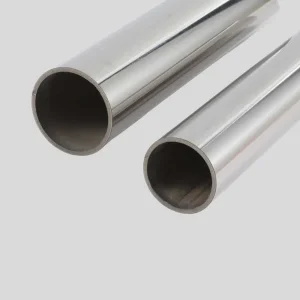
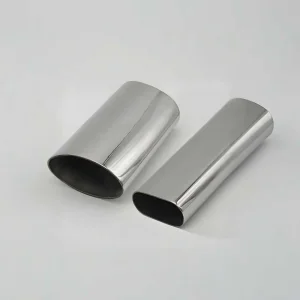
In high-end shopping malls, staircases, and coastal balconies, traditional polished handrails show smudge marks and fingerprint grease within hours. Utilizing 1.5mm embossed round or oval tubing provides an elegant aesthetic, conceals handling marks, and delivers high structural tensile strength during crowded emergency events.
Primary Grade: Ferritic 409L / Austenitic 304
Thickness: 1.5 mm
Emboss Pattern: Micro-peened Dimple Matrix
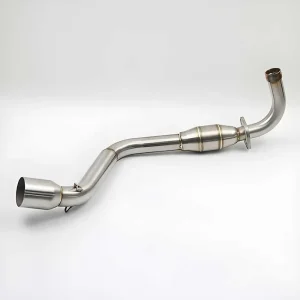
Automotive OEMs require lightweight, heat-dissipating exhaust tailpipes and muffler shell covers. The 1.5mm dimpled embossed pipe increases total cooling surface area, attenuates acoustic harmonic resonance within the muffler, and resists road debris impact better than flat sheet fabrications.
Primary Grade: 201 / 304 Stainless Steel
Thickness: 1.5 mm
Emboss Pattern: Linear Ridged Anti-Slip
In automated parcel sorting facilities and food packaging plants, conveyor roller shells require tight Total Indicator Runout (TIR) and enhanced friction against rubber drive belts. Embossed 1.5mm tubes prevent drive belt slippage under heavy payload acceleration while providing corrosion immunity during wash-down cycles.
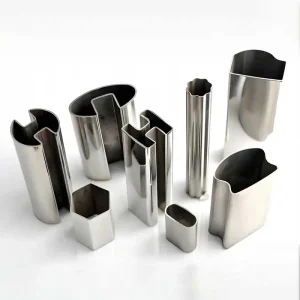
Explore additional profile configurations including special shapes, sanitary grade tubes, and decorative finishes.
Direct solutions to common manufacturing, metallurgical, and shipping queries compiled by our senior quality control engineers.