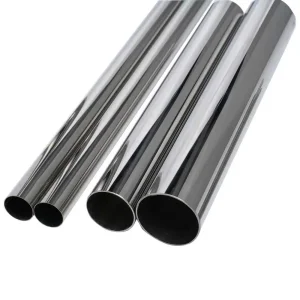
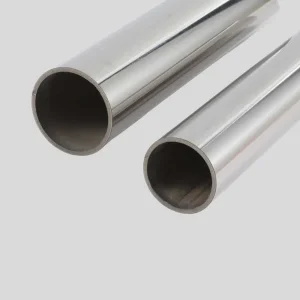
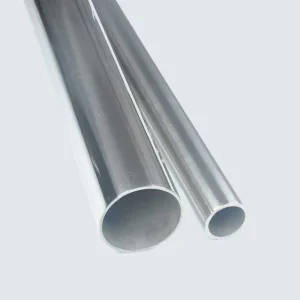
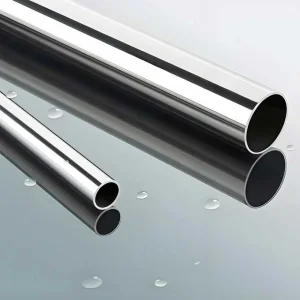
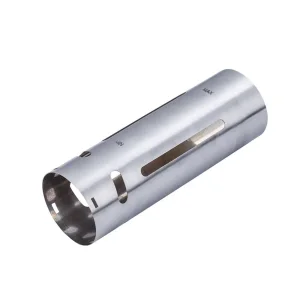
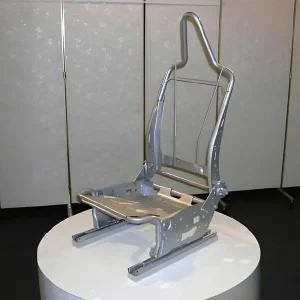
Explore our primary factory-direct OEM/ODM structural and decorative stainless steel tube series engineered to international standards.
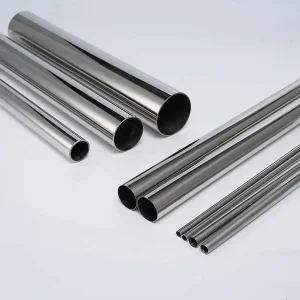
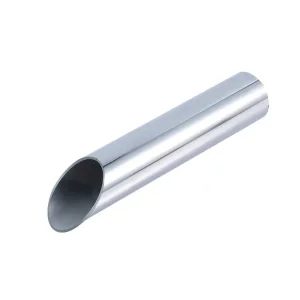
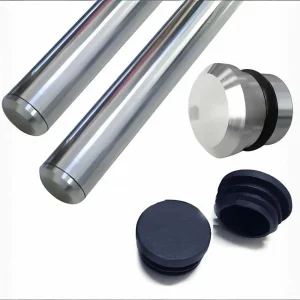
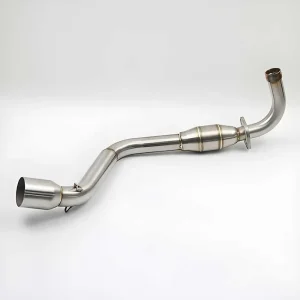
How advanced Original Design Manufacturing (ODM) mills solve complex surface micro-roughness, directional grain consistency, and structural integrity challenges across global supply chains.
Hairline (HL) finish—often designated as Satin or No.4 finish under ASTM specifications—demands absolute mechanical precision. Unlike standard mill finishes or mirror polishing, Hairline processing involves continuous, parallel abrasive brushing using silicon carbide or aluminum oxide belts (typically 180# to 320# grit). This creates fine, unbroken linear scratches aligned perfectly along the longitudinal axis of the stainless steel tube.
A critical challenge in mechanical brushing is preserving the passive chromium oxide (Cr₂O₃) protective film. Sub-standard factories generate localized frictional heat during polishing that strips chromium from the matrix, causing micro-voids where chloride ions accumulate. VertexFlow utilizes online wet-brushing cooling systems combined with chemical passivation baths to ensure a corrosion-resistant barrier across every linear meter.
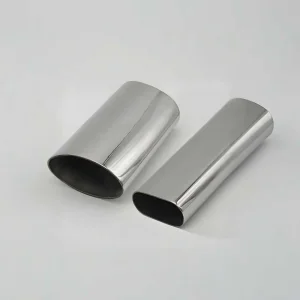
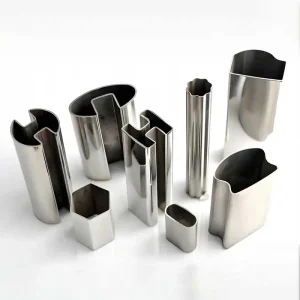
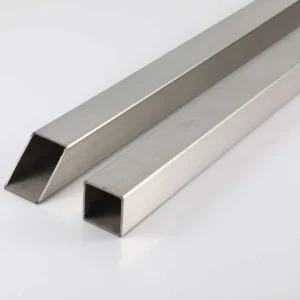
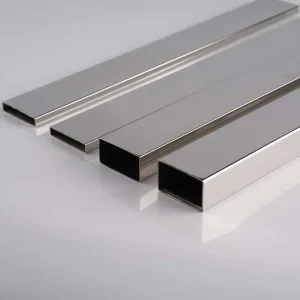
Modern commercial specifications go beyond standard round tubing. Original Equipment Manufacturers (OEM) and Original Design Manufacturers (ODM) require custom geometric profiles—such as flat oval, D-shape, sharp-corner square, and asymmetric channels. Operating over 500 proprietary roll-forming dies allows rapid prototyping and zero-tooling-cost production for international architectural projects.
In high-end architectural and sanitary manufacturing, tactile response and optical reflectance are governed by strict micro-inch and micrometer thresholds. Standard Hairline finishes range between Ra 0.2 µm and 0.4 µm. Achieving Ra < 0.2 µm while retaining distinct parallel grain structure requires dual-stage abrasive belts with synchronized line-speed tension control—eliminating surface "chatter marks" common in low-tier tube production.
| Finish Designation | Abrasive / Process Method | Roughness Average (Ra) | Primary Industrial Application | Reflectivity & Aesthetics |
|---|---|---|---|---|
| Hairline (HL / Satin) | Continuous 180#-320# Silicon Carbide Belts | 0.2 µm – 0.4 µm | Architectural Railings, Appliances, Elevators | Muted, non-glare, parallel linear texture |
| No.4 Finish | Short-interrupted abrasive brushing | 0.4 µm – 0.8 µm | Commercial Kitchens, Food Processing | General utility satin with short grain lines |
| 600# Mirror Polish | Multi-pass sisal cloth + buffing compound | ≤ 0.05 µm | Luxury Furniture, Cleanrooms, Marine Trim | High optical reflectivity, specular mirror face |
| PVD Titanium Color | Physical Vapor Deposition over HL/Mirror | Depends on Substrate | High-End Hardware, Decorative Cladding | Metallic hues (Rose Gold, Black Ti, Brass) |
Analyzing procurement shifts, regional manufacturing clusters, cost structures, and technical standards across Europe, North America, and the Foshan Supply Chain Ecosystem.
Foshan, Guangdong, represents the highest concentration of specialized welded stainless steel tube manufacturing worldwide. The regional ecosystem integrates raw coil slitting, high-frequency TIG/Plasma welding mills, chemical passivation, precision polishing, and export packaging within a 30-kilometer radius.
This structural density allows direct sourcing of prime parent coils from primary steelmakers (TISCO, POSCO, Baosteel) while minimizing transport overhead. For global buyers, this translates into shorter production lead times (typically 15 days), strict batch-to-batch chemical homogeneity, and competitive pricing per metric ton.
International procurement managers in North America and Europe face shifting trade regulations, anti-dumping duties, and volatile raw material surcharges (Nickel and Molybdenum pricing). Overseas buyers increasingly seek ODM partners capable of delivering assembly-ready, cut-to-length, and CNC-bent tubular components rather than raw 6-meter mill lengths.
By performing secondary fabrications—such as laser slotting, necking, and end flaring—in-house, factories reduce container volumetric waste and allow downstream assembly plants to eliminate labor-intensive fabrication steps.
Selecting the correct alloy for Hairline finish tubing requires calculating the Pitting Resistance Equivalent Number (PREN): PREN = %Cr + (3.3 x %Mo) + (16 x %N). While AISI 304 offers a standard PREN of ~19 (suitable for dry interior architectural furniture), coastal balustrades and marine hardware mandate AISI 316L with 2.0-3.0% Molybdenum, elevating the PREN to ≥ 23 to resist atmospheric chloride pitting under humid ocean breezes.
Eliminating weld-line oxidation, pinholes, and dimensional drift through integrated continuous production controls.
Cold-rolled prime coils from TISCO and Baosteel undergo high-precision slitting with dynamic edge deburring. Controlling width tolerances within ±0.03 mm prevents seam overlap during high-frequency forming.
Automated continuous plasma arc welding fuses strip edges cleanly. Welding parameters are locked electronically per tube size, ensuring complete joint penetration without micro-porosity.
Pure nitrogen gas purging floods the tube interior during the welding phase, displacing atmospheric oxygen. This prevents interior bead oxidation—eliminating black scale formation inside the bore.
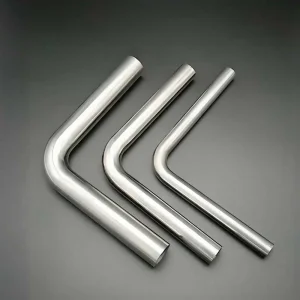
Internal and external seam rollers smooth the weld bead continuously before sizing. This guarantees a seamless structural profile required for subsequent mandrel tube bending.
Real-time eddy-current non-destructive testing scans 100% of the weld length at line speed, automatically tagging and rejecting pinhole defects prior to mechanical polishing.
Tubes pass through four sequential abrasive head stations. Automated belt tensioning maintains constant contact pressure, ensuring uniform grain depth from end to end.
Tailoring hairline finished tubing to rigorous structural, aesthetic, and sanitary environments across global markets.
Architectural glass railings and balustrades require square and rectangular tubing with sharp 90-degree corner radii (R ≤ 1.5 x thickness) and seamless face flatness. Standard rounded corners cause silicone glass gasket seals to slip under thermal expansion. VertexFlow precision-formed square hairline tubing allows clean glass channel fitting without extra shimming.
In hospital grab bars and transfer furniture, surface finish directly influences bacterial cleanability and grip ergonomic texture. A hairline finish polished to Ra 0.3 µm provides tactile friction without deep crevices that trap pathogens, outperforming smooth chrome-plated carbon steel that chips under disinfectant spraying.
Replacing traditional plastic-coated lean pipe, solid 304/316L hairline tubing eliminates particle shedding and coating peel in semiconductor cleanrooms and pharmaceutical wash-down zones. High bending strength allows high load-bearing capacities for modular trolley systems.
Verifiable metallurgical certification, global standard compliance, and risk-mitigated export logistics support.
Every shipment from VertexFlow is backed by a fully traceable EN 10204 3.1 Mill Test Certificate (MTC) detailing chemical heat analysis, yield strength, tensile ultimate strength, elongation percentage, and hardness metrics (HRB/HV). Tubes undergo compulsory mechanical testing:
To preserve pristine Hairline surfaces across multi-week ocean transport, each tube is individually fitted with a UV-stabilized, laser-peelable PE protective film (70 to 100 microns thick). Bundles are secured with waterproof woven plastic wrappings, wrapped in corrugated sheets, and anchored inside heavy-duty wooden boxes or steel-frame crates to avoid transit vibration rubbing.
Next-generation technological advancements in stainless steel tube manufacturing and smart surface engineering.
Transitioning from manual visual sampling to in-line high-speed AI machine vision systems. Multi-angle laser sensors scan 100% of tube surfaces to detect grain inconsistencies or micro-scratch defects at line speeds of up to 40 meters per minute.
Developing zero-discharge, eco-friendly dry-brushing and citric acid passivation technology. Closed-loop filtration systems recycle 98% of process water while eliminating nitric-hydrofluoric acid effluents.
Synthesizing Hairline brushing with continuous Physical Vapor Deposition (PVD). Depositing micro-thin (0.3 µm) Titanium-Aluminium-Nitride (TiAlN) coatings yields scratch-proof, highly corrosion-resistant metallic colors for marine luxury applications.
Direct technical answers to common engineering, quality control, and sourcing queries.
Browse additional marine, automotive, medical, and custom CNC fabricated stainless steel tube categories.