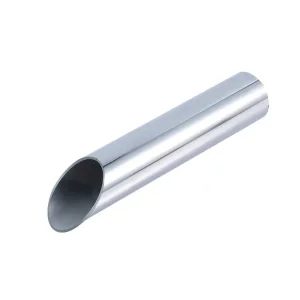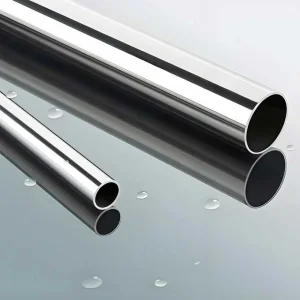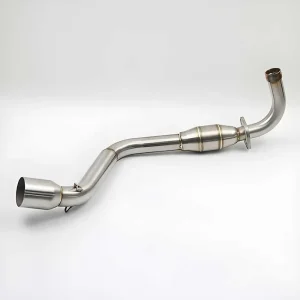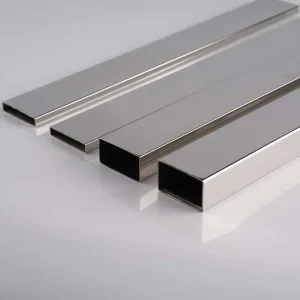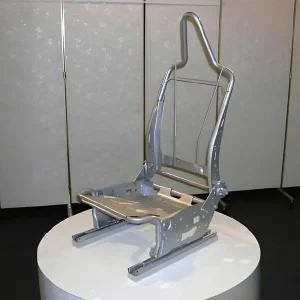
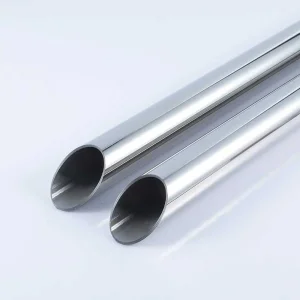
Explore our core OEM/ODM product portfolio engineered for commercial kitchens, medical cleanrooms, industrial workstations, and luxury architectural furniture.
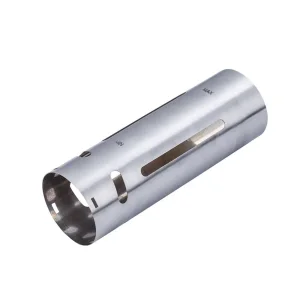
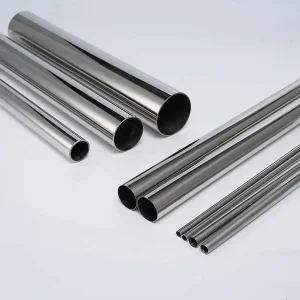
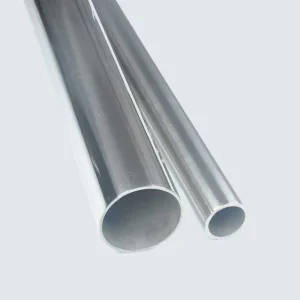
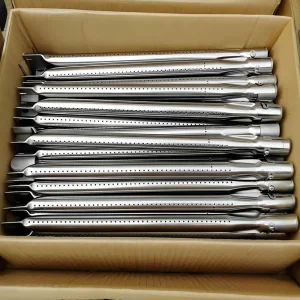
Analyzing structural shifts in material selection, global supply chains, and the engineering requirements for custom ODM stainless steel leg support assemblies.
In modern industrial design, commercial gastronomy, laboratory engineering, and cleanroom infrastructure, the worktop leg is no longer viewed as a static support piece. It is a critical structural element that dictates load distribution, operational hygiene, vibration damping, and overall equipment lifespan. As original equipment manufacturers (OEMs) and original design manufacturers (ODMs) face stringent global standards—ranging from NSF/ANSI Standard 2 for food equipment to ISO 14644 cleanroom compliance—the shift toward specialized stainless steel tubular legs has accelerated rapidly.
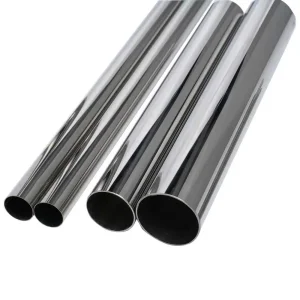
Historically, commercial worktables relied on painted carbon steel, cast iron, or low-cost chrome-plated iron tubing. However, these materials suffer from severe operational drawbacks: coating degradation, corrosion at moisture-laden floor interfaces, micro-cracking during heavy dynamic loading, and continuous particulate shedding. Today’s industrial procurement landscape demands high-yield, corrosion-resistant austenitic stainless steel hollow structural sections (HSS), primarily fabricated from ASTM A554 welded round, square, and custom profile tubing.
Commercial kitchens and pharmaceutical labs require crevice-free geometries, fully sealed weld seams, and non-porous surfaces to prevent bacterial colonization and pass continuous CIP (Clean-in-Place) washdowns.
Global brands require proprietary mounting flange designs, integrated leveling thread inserts (M12 to M20), spring-loaded telescoping height adjustments, and pre-drilled CNC gusset channels.
From 320# satin brushing for industrial machinery to 600# mirror polishing and PVD (Physical Vapor Deposition) decorative titanium coatings for architectural installations, surface consistency is non-negotiable.
Selecting the optimal stainless steel alloy and structural geometry to maximize column strength, corrosion resistance, and total yield performance.
The structural integrity of a worktop leg under compression depends on two core parameters: the alloy's metallurgical composition (determining yield strength $R_{p0.2}$ and corrosion resistance) and section geometry (governing column buckling limit via Euler’s Critical Load formula). Below is a comprehensive engineering comparison of primary stainless steel grades used in ODM worktop leg manufacturing.
| Stainless Grade | Nominal Composition | Yield Strength ($R_{p0.2}$) | PREN (Pitting Resistance) | NSS Salt Spray Hours | Primary Application Environment |
|---|---|---|---|---|---|
| AISI 201 (High Cu) | 16-18% Cr, 1-1.5% Ni, 3.5-5.5% Mn, 1% Cu | ≥ 275 MPa | ~16.5 | 48 - 72 Hours | Indoor Furniture Dry residential worktops, interior retail fixtures. |
| AISI 304 (Standard) | 18-20% Cr, 8-10.5% Ni, ≤2% Mn | ≥ 205 MPa | ~19.0 | 240 - 360 Hours | Commercial Foodservice Worktables, institutional kitchens, commercial counters. |
| AISI 316L (Marine/Pharma) | 16-18% Cr, 10-14% Ni, 2-3% Mo | ≥ 220 MPa | ~23.5 - 25.0 | > 500 Hours | Cleanroom & Marine Pharma processing, coastal kitchens, harsh chemical labs. |
| AISI 409L / 430 (Ferritic) | 10.5-11.7% Cr, ≤0.5% Ni, Titanium Stabilized | ≥ 210 MPa | ~11.0 | 24 - 48 Hours | Budget Structural Frame stiffeners, non-exposed internal leg gussets. |
For vertical worktop leg columns, failure typically occurs via elastic buckling rather than direct compressive crushing. Euler’s critical buckling load ($P_{cr}$) is calculated as:
$P_{cr} = \frac{\pi^2 \cdot E \cdot I}{(K \cdot L)^2}$
Where $E$ is Young’s Modulus ($193 \text{ GPa}$ for 304 SS), $I$ is the Area Moment of Inertia, $L$ is the unsupported leg length, and $K$ is the column effective length factor. Increasing wall thickness from $0.9\text{mm}$ to $1.5\text{mm}$ in a $38.1\text{mm}$ OD tube increases the Moment of Inertia by over $48\%$, raising the critical load capacity exponentially while maintaining the same outer dimensions.
The weakest point of an un-engineered welded tube is its longitudinal weld seam. In ODM manufacturing, inferior high-frequency induction welding without internal shielding gas leaves an un-passivated oxide layer on the inner bore, leading to invisible stress corrosion cracking (SCC) under heavy load cycling.
Our mills utilize continuous Plasma-TIG dual-stage welding under an automated 99.999% pure Argon/Nitrogen internal purging atmosphere. This guarantees:
From initial 3D STEP design file consultation to mass CNC precision machining, secondary metal finishing, and custom packaging integration.
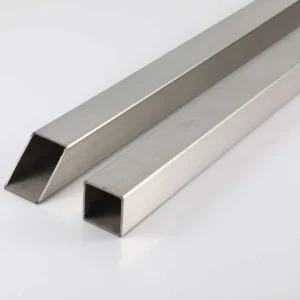
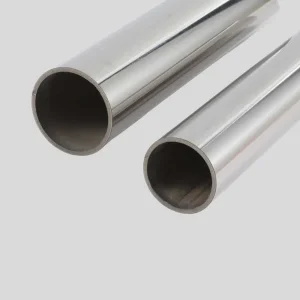
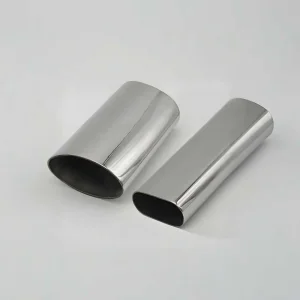
We roll-form standard round sizes (OD 38.1mm, 42.4mm, 50.8mm, 63.5mm) and square sections (38x38mm, 40x40mm, 50x50mm) or develop custom elliptical/D-shaped profiles using in-house tooling dies.
Integration of heavy-duty top mounting plates, triangular die-cast zinc sockets, pressed stainless steel gussets, or direct weld-on flanges for heavy commercial equipment frames.
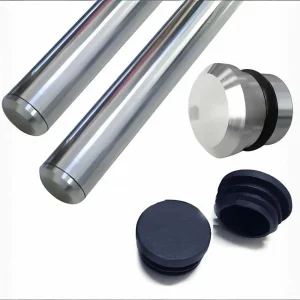
Precision CNC internal threading, heavy-duty M12/M16/M20 stainless steel stem inserts, and non-marking anti-vibration rubber or bullet-type adjustable feet providing up to 50mm height tuning.
Our ODM engineering protocol minimizes lead times while guaranteeing 100% compliance with client specifications:
Deploying specialized stainless steel worktop legs across diverse global sectors requiring specific mechanical, hygienic, and aesthetic parameters.
Grade: AISI 304 / 316L
Designed for heavy commercial prep tables, dishwashing lines, and butcher stations. Features bullet-adjustable leveling feet, NSF certification compliance, and resistance to food acids and degreasers.
Grade: AISI 316L (Electro-polished)
Ultra-smooth surface roughness ($Ra \le 0.2\mu\m$) prevents biological adhesion. Hermetically sealed tube ends with continuous orbital welds withstand aggressive VHP (Vaporized Hydrogen Peroxide) sterilization cycles.
Grade: Heavy-Wall AISI 304 / 201
Built for heavy tooling benches, assembly lines, and lean manufacturing racks. Incorporates thick gusset plates, ESD (Electrostatic Discharge) grounding paths, and dynamic load ratings up to 1,500 kg per table assembly.
Grade: AISI 304 with PVD Finish
Modern kitchen islands, boutique retail display tables, and executive furniture. Available in titanium PVD color coatings (Rose Gold, Champagne Gold, Matte Black, Brushed Brass) with scratch-resistant protective lacquer.
Addressing common structural and metallurgical degradation points in commercial worktop legs before product rollout.
Root Cause: Free iron contamination during mechanical polishing or exposure to airborne chlorides in coastal/coastal kitchen environments attacking 304 passive layer.
ODM Prevention Solution: Post-fabrication chemical pickling and passivation treatment per ASTM A380, or upgrading critical exterior installations to Mo-bearing 316L stainless steel.
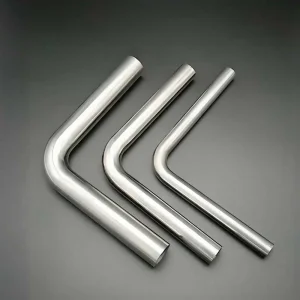
Root Cause: High-frequency induction weld brittleness, improper annealing, or orienting the weld seam directly along the outer tension radius during CNC mandrel bending.
ODM Prevention Solution: In-line bright annealing at $1050^\circ\text{C}$ to fully soften the heat-affected zone, coupled with optical weld-seam positioning prior to CNC bending operations.
Root Cause: Cold welding between identical stainless steel male leveling threads and female internal leg inserts under high compressive loads without lubrication.
ODM Prevention Solution: Differential alloy selection (e.g., 304 leg insert paired with brass or coated steel threaded stem) or application of dry-film anti-seize lubricant coatings.
Emerging trends redefining performance, automation, and environmental sustainability in structural tubular leg fabrication.
Integration of internal linear motor actuators within hollow stainless legs, enabling whisper-quiet, push-button height adjustability for dynamic industrial and lab ergonomic workstations.
Transitioning to scrap-recycled stainless steel coils powered by solar-grid mills, reducing embodied carbon by up to 65% and delivering complete carbon footprint documentation for LEED projects.
Fully automated 6-axis laser cutting cells executing tube slotting, end coping, and mounting hole punching in a single continuous pass, eliminating post-machining deburring cycles.
Answers compiled directly by our senior metallurgical engineers and ODM procurement experts.
Under static vertical compression with standard gusset top mounting plates and fully threaded leveling feet, a 4-leg assembly using 38.1mm OD x 1.2mm wall 304 SS tubing has a certified safe working load (SWL) of 600 kg (1,320 lbs), assuming an unsupported height under 850mm. Upgrading to a 1.5mm wall increases SWL to 900 kg (1,980 lbs).
We maintain strict digital Ra surface roughness logging using contact profilometers across all four automated mechanical polishing lines. For 320# satin brushing, target Ra is held between 0.28$\mu\m$ and 0.35$\mu\m$. For 600# mirror polish, surface reflection is measured via digital gloss-meter ensuring > 95 GU (Gloss Units) across every production heat.
For standard profile tubes (round 38.1mm/50.8mm, square 40x40mm) requiring custom length cutting, punching, and threading, MOQ is 500 units with a 15-day mass production lead time. Rapid prototyping with 3D-printed metal/machined samples takes 5-7 working days following CAD drawing approval.
Yes. We operate industrial PVD (Physical Vapor Deposition) vacuum chambers capable of depositing 0.3-0.5$\mu\m$ thick titanium nitride/carbonitride ceramic layers. Available colors include Champagne Gold, Rose Gold, Titanium Black, Antique Brass, and Bronze—all delivering superior scratch resistance compared to wet painting or powder coating.
We press-fit CNC-machined heavy-duty internal threaded sockets (typically 304 SS or heavy brass) into the bottom tube end, secured via multi-point orbital crimping or continuous 360-degree perimeter TIG welding. This prevents insert pull-out or internal thread shearing even under max rated dynamic loads.
Industrial, medical, structural, and decorative tubular solutions manufactured to international ASTM, EN, and JIS standards.