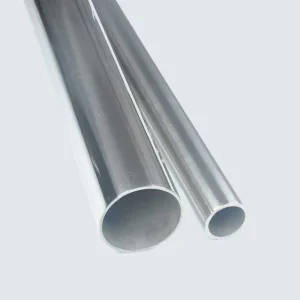
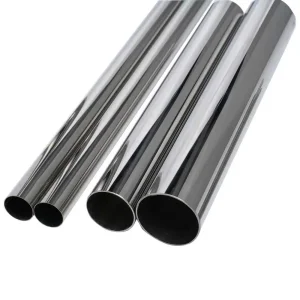
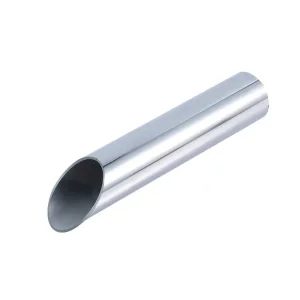
Explore our factory-direct wholesale offerings engineered for demanding architectural balustrades, marine structures, and hygienic applications.
Analyzing the global convergence of building safety codes, metallurgical advances, and life-cycle economics in public and industrial infrastructure.
Studies in human kinesiology demonstrate that an outer diameter between 38mm and 42mm permits maximal opposition of the thumb and index finger during unexpected slip-and-fall events. Specifying 38mm OD tubing lowers power-grip fatigue while maximizing frictional retention under elevated vertical loads across commercial stairwells and transit platforms.
Stainless steel structural components contribute directly to LEED v4.1 Material & Resources credits. Manufactured with up to 85% recycled scrap content, our 38mm handrail tubing exhibits zero VOC off-gassing, indefinite structural longevity, and complete closed-loop recyclability at end-of-life, drastically mitigating Scope 3 embedded carbon footprints.
While carbon steel handrails with epoxy coatings require routine repainting and exhibit high maintenance overheads due to blistering and chipping, 38mm austenitic (304/316L) tubing utilizes a self-healing chromium-oxide ($Cr_2O_3$) passive layer. This delivers a 40-year maintenance-free operational envelope in heavy-traffic environments.
Detailed chemical composition, pitting resistance metrics, and mechanical properties tailored to global climate zones and structural load profiles.
Enterprise B2B procurement managers across Europe, North America, the Middle East, and Asia-Pacific face distinct environmental stressors. Selecting the appropriate alloy formulation for 38mm handrail tubing determines long-term resistance to chloride-induced stress corrosion cracking (SCC), micro-pitting, and atmospheric tea-staining.
| Alloy Grade | UNS / EN Standard | Chemical Composition Key (%) | PREN Value | Yield Strength ($R_{p0.2}$) | Primary Global Application Zone |
|---|---|---|---|---|---|
| AISI 201 (High Cu) | S20100 / 1.4372 | 16-18 Cr, 1-1.5 Ni, 5.5-7.5 Mn, 1.0 Cu | ~17.5 | ≥ 350 MPa | Indoor furniture, commercial interior dry balustrades, retail display systems. |
| AISI 304 | S30400 / 1.4301 | 18.0-20.0 Cr, 8.0-10.5 Ni, ≤ 0.07 C | ~19.0 | ≥ 205 MPa | Standard indoor/outdoor urban infrastructure, transit centers, hospital corridors. |
| AISI 316 | S31600 / 1.4401 | 16.0-18.0 Cr, 10.0-14.0 Ni, 2.0-2.5 Mo | ~23.1 | ≥ 220 MPa | Coastal walkways, outdoor swimming pool railings, high-humidity chemical plants. |
| AISI 316L | S31603 / 1.4404 | 16.0-18.0 Cr, 10.0-14.0 Ni, 2.0-3.0 Mo, ≤ 0.03 C | ~25.0 | ≥ 200 MPa | Heavy industrial washdown areas, marine handrails welded on-site, offshore rigs. |
| Duplex 2205 | S32205 / 1.4462 | 22.0 Cr, 5.0 Ni, 3.0 Mo, 0.18 N | ~35.0 | ≥ 450 MPa | Extreme marine splash zones, high-wind glass railing top channels, sub-zero bridges. |
From prime slit coil to continuous high-frequency TIG/Laser welding, internal bead removal, and multi-pass surface finishing.
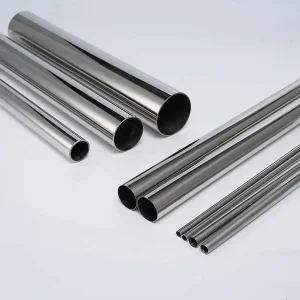
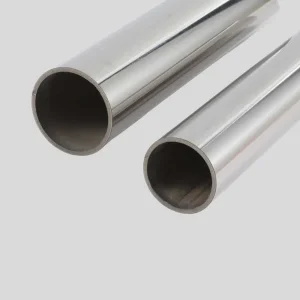
Prime cold-rolled steel coils from top-tier mills (TISCO, POSCO, Baosteel) are slit to exact developed width tolerances. The strip passes through multi-stage precision forming rollers into a continuous 38mm cylinder. Automated high-frequency TIG or fiber laser welding fuses the seam under 99.999% argon purge gas, preventing inner bore oxidation and burning of alloying elements.
To ensure structural integrity and a completely smooth tactile touch, the internal weld bead is mechanically planished flush with the parent wall profile. Integrated continuous Eddy Current Testing (per ASTM A1016 / EN 10246) scans 100% of the tubing at line speed to detect micro-porosity, weld pinholes, or incomplete fusion before sizing.
For handrail applications requiring tight-radius CNC mandrel bending (e.g., $1.5D$ bend ratios for elbows and return bends), 38mm tubes undergo bright hydrogen atmosphere annealing at 1,050°C. This restores full austenitic ductility, relieves residual cold-working stress, and eliminates work-hardening cracks during downstream field fabrication.
Tubes are processed through automated multi-head polishing centers. Satin/Satin finishes (180#, 240#, 320# grit) are achieved using silicon carbide abrasive belts, while 600# Super Mirror finishes are generated using Sisal buffing wheels and synthetic compound pastes to achieve an ultra-smooth Surface Roughness ($R_a \le 0.1 \mu\text{m}$).
| Dimensional Parameter | Standard Specification | Precision Mill Option | Verification Equipment |
|---|---|---|---|
| Outside Diameter (OD) | 38.10 mm (1.500 in) ± 0.10 mm | ± 0.05 mm | Continuous Laser Micrometer |
| Wall Thickness (WT) | 1.2 mm to 3.0 mm ± 8% | ± 5% | Ultrasonic Wall Thickness Gauge |
| Ovality / Out-of-Roundness | ≤ 0.15 mm | ≤ 0.08 mm | 3D Coordinate Measurement Machine (CMM) |
| Straightness Deviation | 1.0 mm per meter length | 0.5 mm per meter length | Laser Alignment Rail |
| Standard Cut Lengths | 6,000 mm / 5,800 mm (Container Fit) | Custom CNC Cut (± 0.5 mm) | Digital Linear Measurement Encoder |
Smart infrastructure integration, advanced nano-coatings, and automated modular assembly technologies transforming 38mm handrail tubing.
Physical Vapor Deposition (PVD) technology enables atomic-level bonding of Titanium Nitride (TiN) films onto 38mm stainless steel handrail tubes. Available in Rose Gold, Champagne, Black Titanium, and Brass, these 0.4-micron ceramic coats deliver extreme scratch hardness (HV > 2,500) and are coupled with hydrophobic Sol-Gel silica matrices to completely eliminate smudging in high-volume public spaces.
Modern transit hubs are adopting smart 38mm handrails equipped with internal low-power IoT micro-sensors. Hollow 38mm profiles allow hidden routing for optical passenger counting sensors, surface temperature indicators, and integrated LED strip illumination channels. Internal cable pass-throughs eliminate external conduit clutter while meeting strict IP67 water-ingress guidelines.
In hospital environments, high-touch handrails present cross-contamination risks. Emerging metallurgical developments involve adding 1.5-3.0% elemental copper into 316-grade stainless formulations. Micro-segregated copper rich phases continuously release $Cu^{2+}$ ions onto the 38mm handrail surface, actively achieving a 99.9% reduction in bacterial colony counts (MRSA, E. coli) within two hours without manual chemical wipe-downs.
Real-world integration analysis across architecture, healthcare, marine transport, and cleanroom manufacturing.
Airports, metro stations, and high-speed rail terminals demand heavy-duty handrail systems capable of sustaining high cyclic crowd loading. 38mm x 2.0mm or 2.5mm thick AISI 304/316 tubes provide exceptional section modulus ($Z$), resisting lateral line loads exceeding 1.5 kN/m as required by BS 6180 and International Building Code (IBC) structural mandates.
In healthcare environments, safety grab bars must support patient weight while enduring frequent cleaning with harsh disinfectant chemicals (chlorine dioxide, hydrogen peroxide vapors). Smooth 320# Satin or 600# Mirror 38mm tubes eliminate crevice corrosion around mounting flanges, providing non-porous surfaces that prevent biofilm accumulation.
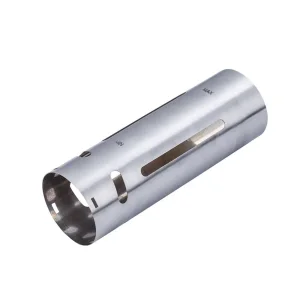
38mm slotted round handrail tubes serve as protective top capping channels for 12mm to 21.52mm laminated toughened glass railings. Engineered with a continuous bottom slot and high-grade EPDM gaskets, the 38mm profile binds structural glass panels together, distributing point-impact energy evenly across adjacent panes.
Replacing traditional plastic-coated lean pipes, 38mm stainless steel tubing offers superior load capacity and high-temperature washdown capabilities in pharmaceutical and food processing plants. Solid stainless construction eliminates peeling, flaking, or particulate contamination in ISO Class 5 cleanrooms.
Rigorous quality management protocols ensuring seamless compliance with international building and metallurgical standards.
Every shipment of 38mm handrail tubing is accompanied by a original Mill Test Certificate (MTC) per EN 10204 3.1. Chemical heats are fully traceable from raw melt to finished product, verifying exact weight percentages of Chromium, Nickel, Molybdenum, and Carbon, alongside yield stress ($R_{p0.2}$), tensile strength ($R_m$), and elongation percentage ($A$).
To guarantee bendability without seam splitting, representative batch samples undergo 180° flattening tests per ASTM A530, tube flaring tests (expanding OD by 1.2x without cracking), and hydrostatic pressure or 100% Eddy Current non-destructive evaluation. Seam strength equals or exceeds parent metal yield stress.
To prevent surface scratches and transit contamination, each 38mm handrail tube is individually sleeved in PE poly-tubing or woven sleeves. Bundles are bundled in heavy-wall corrugated plastic wrapping, steel-strapped, and placed into export-ready fumigated wooden crates or heavy iron frames for container shipping.
In-depth responses from our engineering team regarding specifications, bending, corrosion, and global standards.
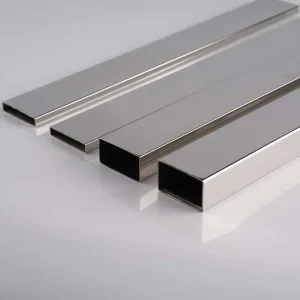
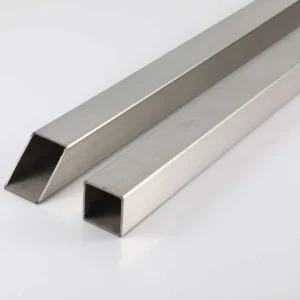
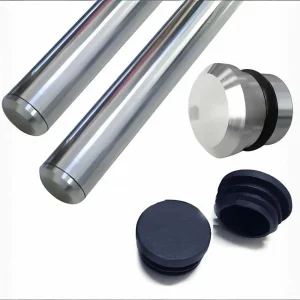
Explore additional specialized tube geometries, structural shapes, and industry-specific fabrication solutions from our factory mills.