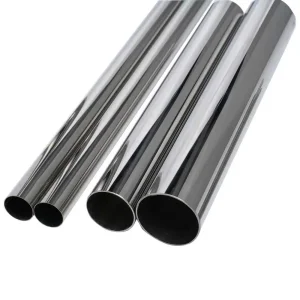
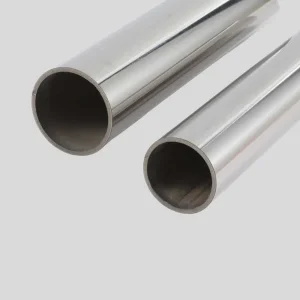
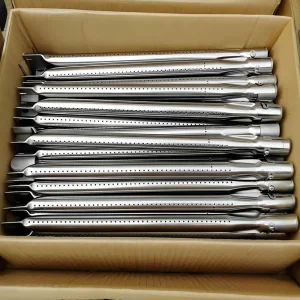
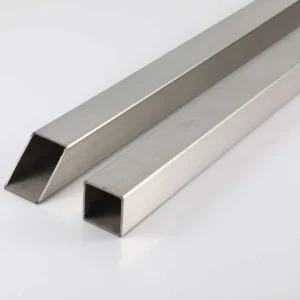
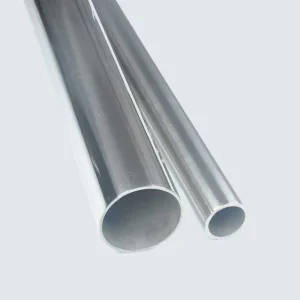
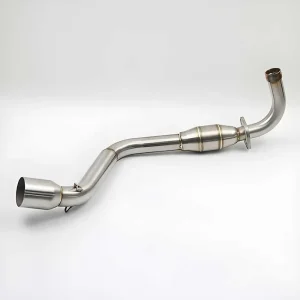
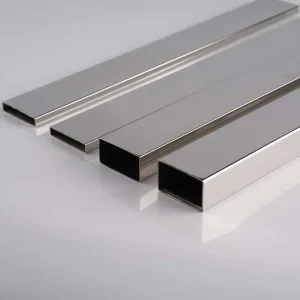
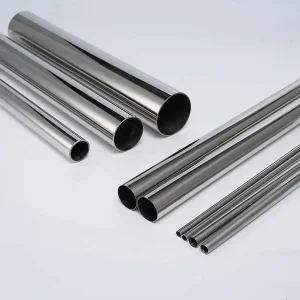
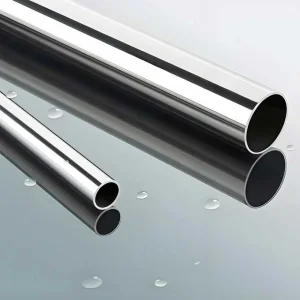
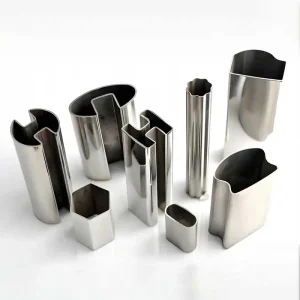
Explore our specialized structural, ornamental, and high-purity flat oval and custom-shaped welded tubing engineered to ASTM A554 and EN 10217-7 standards.
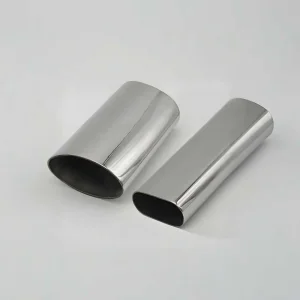
Flat oval stainless steel tubing represents an optimal synthesis of aerodynamic efficiency, asymmetrical moment of inertia, and sleek aesthetic presentation.
Unlike standard round or square hollow sections, Flat Oval Stainless Steel Tubing delivers directional bending resistance along its major axis ($A$) while retaining a minimal cross-sectional envelope along its minor axis ($B$). This anisotropic moment of inertia ($I_x$ vs $I_y$) enables design engineers to minimize mass without sacrificing structural rigidity.
Fabricated through cold-roll forming and continuous plasma or laser welding from high-grade austenitic (AISI 304, 316L) or ferritic (AISI 409L) stainless steel coils, flat oval tubing undergoes precise dimensional sizing. The smooth planar sides joined by semicircular or radius ends reduce wind resistance in architectural louvers and mitigate drag in automotive aerodynamic underbodies.
Selecting the correct tubing geometry depends heavily on load distribution, spatial constraints, and aesthetics. The table below details the performance trade-offs:
| Profile Geometry | Directional Stiffness | Aerodynamic Drag ($C_d$) | Ergonomic Grip Index | Primary Industry Applications |
|---|---|---|---|---|
| Flat Oval Tube | High (Major Axis) / Medium (Minor Axis) | Very Low (~0.3) | Superior (Natural Hand Contour) | Architectural Balustrades, Medical Grab Bars, Automotive Seat Frames |
| Standard Round Tube | Isotropic (Uniform 360°) | Moderate (~0.47) | Standard | General Fluid Transport, Structural Frameworks, Exhaust Systems |
| Square / Rectangular | High (Planar Forces) | High (~1.05) | Low (Sharp Edges) | Industrial Machine Frames, Cleanroom Workstations, Heavy Racks |
| Elliptical Tube | Moderate-High | Extremely Low (~0.2) | Good | Heat Exchanger Fins, Specialized Aerospace Condensers, Decorative Trim |
How global tier-1 manufacturers and local engineering contractors leverage flat oval stainless tubing for maximum structural efficiency.
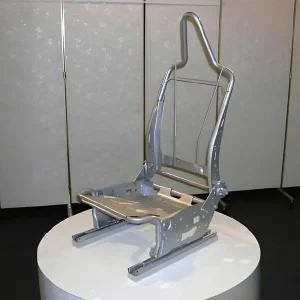
Flat oval tubing is extensively integrated into automotive seating sub-frames and side-impact door beam assemblies. In electric vehicle (EV) lightweighting initiatives, replacing solid bar stock or bulky rectangular tubing with hydroformed 304/409L flat oval profiles reduces frame mass by up to 18% while maintaining energy absorption capacity during crash deformation tests.
In healthcare environments, flat oval tubing provides an ergonomically comfortable palm contact surface compared to cold, narrow round bars. Grade 316L stainless steel flat oval tubes are manufactured with Ra ≤ 0.4 μm mirror polishing, offering seamless washdown capability that resists harsh quaternary ammonium disinfectant chemicals without surface pitting or microbial entrapment.
Modern commercial buildings use vertical and horizontal flat oval louver systems to control thermal loading. The aerodynamic contour minimizes wind noise at high elevations while providing structural rigidity across large glass curtain wall spans. PVD titanium black, gold, and brushed brass finishes protect external surfaces against atmospheric corrosion and UV degradation.
In coastal marine installations, standard 304 tubing often suffers from salt-air tea-staining along weld lines. ODM marine-grade 316L flat oval tubing undergoes full-length internal seam planishing, solution annealing, and chemical passivation, successfully withstanding over 500 hours of neutral salt spray testing (ASTM B117).
Flat oval stainless tubes are increasingly specified in industrial condensers and HVAC recovery systems. The wide surface area increases fluid heat-transfer coefficients while lowering fluid pressure drop inside closed loops compared to equivalent round tube bundles.
From high-end retail display racks to minimalist designer sofa frames, flat oval tubing provides a distinct aesthetic separation from traditional tubular furniture. High-copper 201 and 304 grades offer excellent tight-radius bendability without wall-buckling or seam cracking.
A transparent breakdown of our 10-stage quality-controlled process for zero-defect flat oval stainless tube production.
The manufacturing process begins with prime stainless steel coil stock sourced exclusively from tier-1 steel mills (TISCO, POSCO, Baosteel). Cold-rolled strip is slit to micro-calibrated widths with zero edge burr, preventing localized stress concentrations during forming.
The flat strip passes through multi-stage precision tungsten-carbide forming rolls. Our mills utilize continuous Plasma / High-Frequency TIG Hybrid Welding under a 99.999% pure inner nitrogen gas shield. This completely eliminates internal weld seam oxidation, ensuring a pristine inner bore.
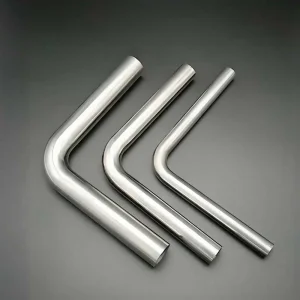
To prepare flat oval tubing for severe secondary operations like 90-degree mandrel bending, flare necking, or flattening, the internal weld bead is mechanically planished flush. The tube then enters progressive oval shaping dies that slowly form the flat oval contour without work-hardening the metal corner radii.
100% of manufactured tubing passes through an online infrared seam detector and continuous Eddy Current test unit per ASTM A1016/A1016M. Any pinhole defect, micro-crack, or dimensional deviation of >0.05 mm triggers automated inline ejection.
Depending on end-use requirements, tubes pass through four-stage automated polishing lines to achieve:
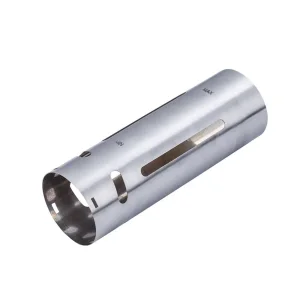
Equipped with high-speed automatic CNC laser cutting and tube bending units, we deliver ready-to-assemble cut lengths (±0.3 mm tolerance), punched slot profiles, flared ends, and bent sub-assemblies directly to OEM factory floors.
Located in Foshan—the world's densest stainless steel manufacturing cluster—our facility offers unparalleled speed, flexibility, and supply chain security.
Custom profile tooling can add thousands of dollars and weeks of delay to OEM procurement schedules. VertexFlow maintains a library of over 500 existing flat oval and special profile roll-forming dies, allowing global buyers to source non-standard dimensions with zero tooling investment and zero mold lead time.
Our strategic alignment with Foshan’s stainless steel ecosystem grants immediate access to premium grade 201, 304, 304L, 316L, and 409L hot/cold-rolled coils. We lock in raw material pricing during market troughs, passing structural cost savings directly to wholesale volume buyers.
Operating 43 automated mill lines in parallel gives our 12,000 m² facility a monthly capacity exceeding 900 metric tons. Standard mill orders ship within 15 calendar days from artwork/sample approval, supported by flexible 500 kg MOQ thresholds.
Ensuring complete chemical, mechanical, and regulatory compliance across all international import markets.
Every shipment of flat oval stainless steel tubing is delivered with a full EN 10204 3.1 Mill Test Certificate (MTC) detailing heat number traceability, chemical ladle analysis, yield strength ($R_{p0.2}$), tensile strength ($R_m$), percentage elongation ($A$), and hardness values (HRB/HV).
Our quality control laboratory conducts batch testing including:
International ocean freight presents humidity and physical impact risks. We employ multi-layer protective packaging systems engineered for global transit:
Expert engineering answers to real-world procurement and fabrication queries.
Bending flat oval stainless steel tubing requires evaluating whether the bend occurs across the major axis ("easy way") or the minor axis ("hard way"). For a standard 90° bend using rotary draw mandrel bending equipment, the general rule of thumb for 304/316L stainless is:
For thin-wall tubing ($t \le 1.0 \text{ mm}$), an internal wiper die and flexible ball mandrel must be used to prevent inner wall wrinkling and outer wall thinning/cracking. Position the weld seam along the neutral axis (3 o'clock or 9 o'clock relative to the bend direction) to minimize seam tension.
Tea-staining occurs when airborne chloride ions (from sea spray or de-icing salts) break down the microscopic passive chromium-oxide ($Cr_2O_3$) film on Grade 304 stainless steel. Pitting corrosion initiates in tiny surface crevices or where free iron particles were embedded during cold-roll forming.
Solution: For coastal or high-humidity marine applications, specify Grade 316L Stainless Steel (containing 2.0–3.0% Molybdenum). Additionally, ensure the tube undergoes full chemical pickling and passivation to remove free iron and reinforce the passive film layer.
ASTM A554 is the standard specification for welded stainless steel mechanical and ornamental tubing. It focuses primarily on dimensional tolerances, surface finish quality, structural strength, and bendability. It does not require hydrostatic pressure testing.
In contrast, fluid standards like ASTM A249 / A269 / A270 cover pressure tubing and sanitary tubing. They require mandatory non-destructive eddy current or hydrostatic testing, solution annealing at 1040°C+, and strict internal bore roughness controls ($Ra \le 0.4-0.8 \mu m$). Flat oval shapes are predominantly manufactured under ASTM A554 for architectural, furniture, and structural mechanical use cases.
Yes. Flat oval tubing can be welded using TIG (GTAW), MIG (GMAW), or Fiber Laser welding techniques. When joining flat oval tubing to round posts, 5-axis CNC laser coping or saddle-notching of the flat oval tube end is recommended to ensure a zero-gap fit-up. Use matching filler metals (e.g., ER308L for 304 tube, ER316L for 316L tube) and purge the inner tube bore with argon gas during welding to avoid internal burn-through and oxidation.
Our automated precision mills operate within the following tolerances:
For existing mould profiles in our 500+ die library, the standard MOQ is 500 kg per size and finish. If a brand-new custom profile geometry is required, our tooling team can engineer and cut custom roll-forming dies within 7-10 days, with a trial sample produced shortly after. Production lead times for full container orders are typically 15 days.
Complete your procurement evaluation with our secondary range of ornamental, automotive, and structural special-shaped tubing.