Select standard mechanical profiles, sanitary substrates, and architectural ornamental tubing manufactured directly from our Foshan mill cluster.
Understanding surface topology, mechanical yield integrity, and chemical alloying for global industrial applications.
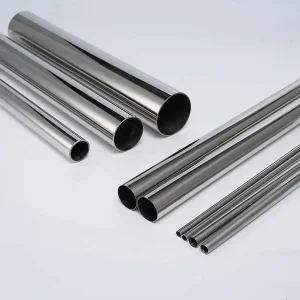
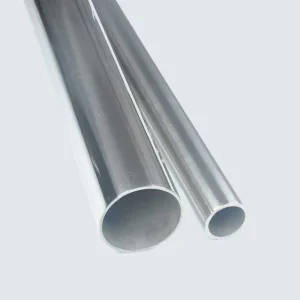
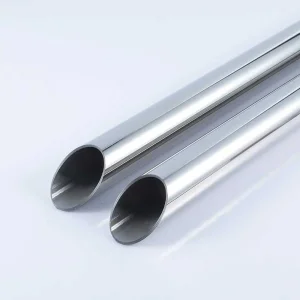
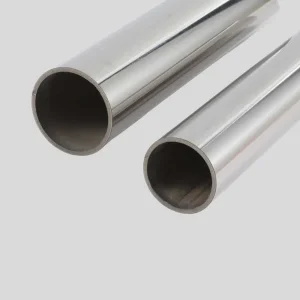
In modern architectural, sanitary, automotive, and industrial engineering, Satin Finish Stainless Steel Tubing represents the optimal convergence between refined aesthetics, tactile ergonomics, and robust corrosion defense. Unlike raw mill finishes or high-reflectivity mirror polishes (600# Grit), a true satin or brushed finish—typically produced using #180, #240, #320, or #400 grit abrasive belts—yields a silky, non-directional or linear directional surface texture with controlled roughness values ($Ra$ parameters ranging strictly between $0.2\,\mu\text{m}$ and $0.6\,\mu\text{m}$).
From a surface physics standpoint, wholesale procurement of satin finish tubing requires rigorous standard control. Improper mechanical polishing can embed microscopic abrasive contaminants or introduce localized frictional heat, causing micro-structural phase changes in austenitic alloys (such as partial transformation of austenite to strain-induced martensite). At VertexFlow Tubes (Foshan), our automated continuous inline polishing machinery maintains constant pressure and flood cooling, preserving chromium passive oxide layer continuity while achieving strict cosmetic consistency across multi-kilometer production runs.
| Material Grade | Standard Spec | Surface Finish (Grit/Ra) | Tensile Strength (MPa) | Corrosion Resistance Level | Primary Industrial Applications |
|---|---|---|---|---|---|
| AISI 304 / 304L | ASTM A554 / A269 | #180 - #320 Satin ($Ra\,0.3-0.5\,\mu\text{m}$) | $\ge 515$ | High (Standard Atmospheric) | Architectural Balustrades, Furniture, Appliances |
| AISI 316 / 316L | ASTM A554 / A249 | #240 - #400 Satin ($Ra\,0.2-0.4\,\mu\text{m}$) | $\ge 620$ | Superior (Marine/Chloride & Acid) | Coastal Railings, Sanitary Bathrooms, Medical Grab Bars |
| 201 (High Cu Alloy) | ASTM A554 (Modified) | #180 - #240 Satin ($Ra\,0.4-0.6\,\mu\text{m}$) | $\ge 520$ | Moderate (Indoor Clean Air) | Cost-effective Storage Racks, Indoor Decorative Trim |
| 409L / 430 Ferretic | ASTM A554 / EN 10217-7 | Brushed / Satin #180 | $\ge 380$ | High Thermal Resistance | Automotive Exhaust Systems, Gas Grill Burner Tubes |
Next-generation metallurgical surface treatments, digital quality control, and zero-defect plasma tube welding technologies.
Integrating Physical Vapor Deposition (PVD) directly over high-precision satin substrates allows creation of wear-resistant metallic color layers (Titanium Black, Rose Gold, Champagne Brass) with ultra-thin ceramic coatings ($0.3 - 0.5\,\mu\text{m}$) that outperform conventional anodizing or wet painting under 1000+ hours UV and salt-spray testing.
Deploying closed-loop dual-axis laser micrometer sensor arrays on all 43 continuous tube mills. This guarantees $\pm 0.05\,\text{mm}$ outer diameter tolerances and automatic wall thinning alerts during roll-forming, eliminating manual sampling errors and guaranteeing 100% seam alignment for CNC automated bending.
Implementation of inner-tube nitrogen gas purge shielding combined with closed-loop bio-degradable chemical pickling. This prevents internal seam oxidation (eliminating the "black line" defect) and offers sterile interior surfaces for medical and sanitary application standards without toxic chemical outflow.
How VertexFlow satin finish tubing solves domain-specific engineering challenges worldwide.
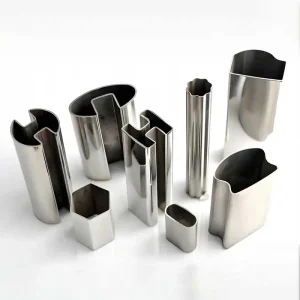
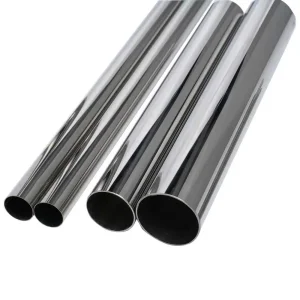
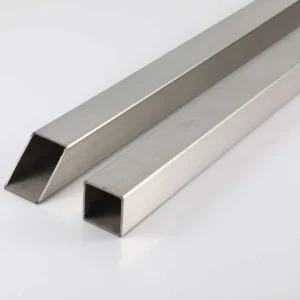
In high-traffic commercial buildings, airport balustrades, and structural glass railings, finger-print visibility and micro-scratching are major maintenance bottlenecks. VertexFlow’s #240 and #320 satin finish ASTM A554 round, square, and slot tubes minimize optical distortion, conceal everyday wear, and provide tactile anti-slip friction for handrail compliance.
Hospital beds, handicap grab bars, and bathroom safety equipment require surfaces that withstand rigorous chemical sanitization (chlorine-releasing agents, isopropyl alcohol). Our 316L satin tubes undergo passivated surface smoothing ($Ra \le 0.4\,\mu\text{m}$), preventing bacterial bio-film adhesion and intergranular crevice corrosion.
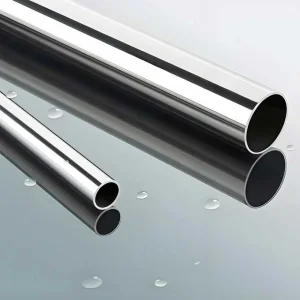
Conveyor roller shells in automated logistics hubs demand extremely low Total Indicator Runout (TIR) and zero vibration. VertexFlow manufactures high-precision 304/316L round tubes with controlled straightness ($1\,\text{mm/m}$) and uniform satin textures, preventing belt slipping while resisting wash-down chemicals.
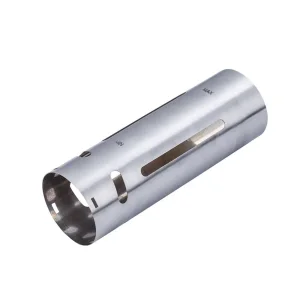
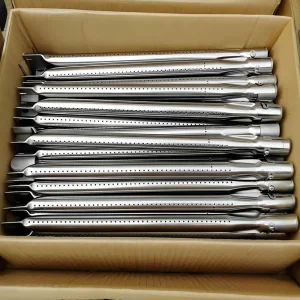
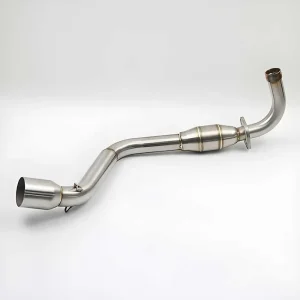
Gas grill burner tubes and automotive mufflers operate under aggressive cyclic thermal stress ($> 650^\circ\text{C}$). Utilizing specialized 409L ferritic and 304 austenitic alloys with laser-cut gas porting, our satin tubing resists thermal oxidation and prevents structural weld seam fatigue under extreme temperature swings.
Capitalizing on vertically integrated raw strip slitting, plasma welding, automated polishing, and immediate container freight access.
Located in the heart of Shishan Town, Nanhai District, Foshan—China's premier stainless steel industrial hub—VertexFlow Tubes Co., Ltd. (Xiyouwo Stainless Steel Group) operates an ultra-lean 12,000 m² smart plant equipped with 43 high-speed continuous tube mills. Strategic vertical integration allows us to procure prime raw steel coils directly from tier-one steelmakers (TISCO, POSCO, Baosteel), perform in-house slitting with zero edge burrs, execute high-frequency plasma/TIG welding, and process surface finishes under a single roof.
Addressing total cost of ownership (TCO), strict compliance, and precision custom fabrication specifications.
Every shipment is issued with standard EN 10204 3.1 Mill Test Certificates (MTC) detailing spectral chemical analysis, tensile strength, yield points, elongation metrics, and flattening/flaring mechanical destruction test results.
To eliminate sea-freight moisture corrosion and surface abrasion during intermodal logistics, each satin tube is individually PE sleeved, bundled, wrapped in heavy-duty waterproof woven fabric, and secured within sea-worthy wooden crates or steel frames.
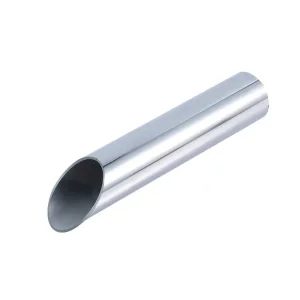
We eliminate double-handling by offering ready-to-assemble OEM components. In-house processing includes precision CNC mandrel bending, laser slotting, end flaring, necking, flow drilling, and robotized seam welding.
Explore tailored tubing grades engineered for high-durability, automotive, marine, and healthcare applications.
Expert technical clarity on grade selection, surface roughness parameters, bending limits, and global shipping.
The numbers denote the grit density of the abrasive belts used during finishing. A #180 grit satin finish yields a slightly coarser, highly durable linear texture ($Ra \approx 0.4 - 0.6\,\mu\text{m}$), ideal for heavy-duty industrial racks and outdoor structural components. A #240 or #320 grit satin finish produces a finer, smoother, silky brushed appearance ($Ra \approx 0.2 - 0.4\,\mu\text{m}$), which is preferred for high-end furniture, sanitary fixtures, and indoor balustrades due to its touch aesthetics and resistance to fingerprint marks.
Tea-staining occurs when airborne chloride ions accumulate in micro-grooves of the satin surface and break down the passive chromium oxide film ($Cr_2O_3$). While 304 performs excellently inland, coastal environments within 5 km of seawater require AISI 316 / 316L stainless steel. Grade 316 contains 2–3% Molybdenum (Mo), which dramatically increases resistance to localized pitting and crevice corrosion under high salt concentrations.
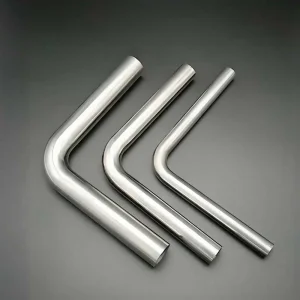
Weld seam failure during tight-radius bending usually stems from localized brittleness, seam misalignment, or insufficient strip ductility. We mitigate this by using high-elongation raw strip, maintaining full-penetration plasma welding with inner nitrogen gas cooling, and controlling inline seam orientation. When rotary-draw bending, orienting the weld seam at $90^\circ$ relative to the bend plane (along the neutral axis) prevents maximum tensile stress from concentrating on the weld line.
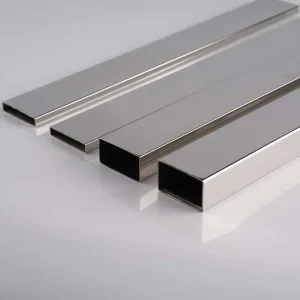
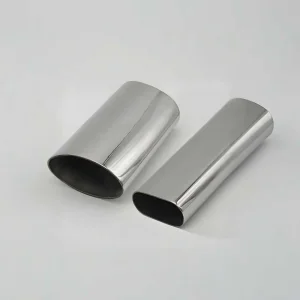
For standard round, square, and rectangular profiles, outer dimensions are held to $\pm 0.10\,\text{mm}$. For precision applications (conveyor rollers, hydraulic sleeves, or specialized oval shapes), our inline laser micrometers achieve tolerances up to $\pm 0.05\,\text{mm}$. Wall thickness is controlled within $\pm 8\%$, squareness of corner profiles is held to $\pm 0.5^\circ$, and overall straightness is guaranteed within $1.0\,\text{mm/m}$.
Our standard Minimum Order Quantity is 500 kg per dimension and finish for common circular and structural square tubes. For specialized custom profile roll-forming or custom PVD color runs, the MOQ is 1,000 kg (1 Tonne). Thanks to our library of 500+ pre-tooled roll-forming dies, typical factory lead time is compressed to 15 days from deposit receipt and artwork approval.
Yes. Over 40% of our global export orders involve secondary OEM fabrication. We operate multi-axis CNC fiber laser cutters, high-speed automated saws, mandrel bending units, and punching presses. We can supply cut-to-length parts (down to $\pm 0.5\,\text{mm}$ cut length tolerance), notched ends, punched mounting holes, flared tube ends, or laser-slotted profiles ready for immediate assembly line integration.