The global commercial and residential architectural furniture market is undergoing a paradigm shift. Procurement directors, structural engineers, and original equipment manufacturers (OEMs) face compounding challenges: shifting tariff structures, stringent environmental compliance mandates, and increasing demand for precision tolerance. Modern table metal understructures have evolved beyond simple load-bearing frames into highly engineered structural assemblies.
Evaluating austenitic vs. ferritic grade performance under high static load, cyclic vibration, and aggressive environmental exposure (indoor cleanrooms to coastal exterior spaces).
Integrating 5-axis fiber laser cutting, robotic TIG/plasma welding, and cold-draw profiling to eliminate structural deflection and maintain tight tolerances (±0.05mm).
Analyzing surface roughness metrics (Ra ≤ 0.4 µm), passivation chemistries, and vacuum Physical Vapor Deposition (PVD) to ensure zero-defect aesthetic finishes.
As commercial real estate, luxury hospitality, and ergonomic workplace designs modernize, structural requirements for metal furniture understructures have deepened in technical complexity.
Modern corporate environments require modularity. Wholesale table legs are no longer static post elements. Factories must now produce high-precision telescoping tube sets with integrated internal wireways, anti-backlash guide bushings, and high-concentricity wall profiles. These features facilitate smooth linear motion in motorized height-adjustable desks without structural wobble at full elevation (up to 1250mm extension).
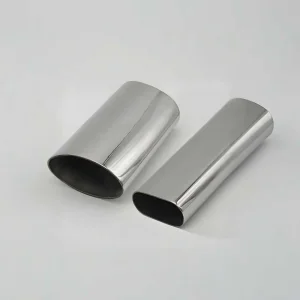
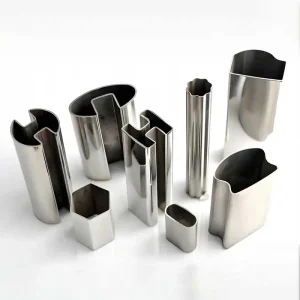
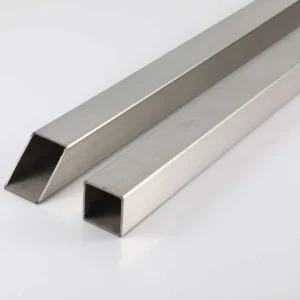
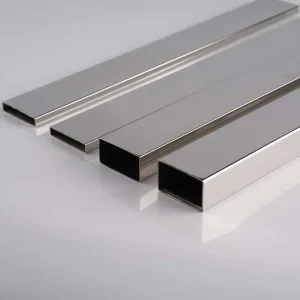
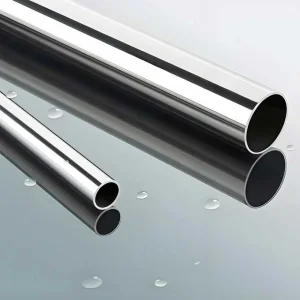
Standard round and square legs are increasingly supplemented by custom profiles, including flat-oval, elliptical, trapezoidal, and triangle-section tubing. Leading export mills rely on extensive internal roll-forming libraries (over 500 tooling sets) to manufacture custom shapes while reducing NRE (non-recurring engineering) tooling costs and shortening time-to-market for bespoke architectural furniture lines.
| Alloy Grade | Chemical Composition Highlights | Tensile Strength (MPa) | Corrosion Resistance | Primary Industrial Application |
|---|---|---|---|---|
| AISI 201 (High Cu) | 16-18% Cr, 3.5-5.5% Ni, High Mn/Cu | ≥ 520 | Moderate (Indoor dry environments) | Cost-effective interior commercial tables, display legs. |
| AISI 304 (UNS S30400) | 18-20% Cr, 8-10.5% Ni | ≥ 515 | High (Standard humidity & washdowns) | Hospitality tables, medical furniture, executive desks. |
| AISI 316L (UNS S31603) | 16-18% Cr, 10-14% Ni, 2-3% Mo | ≥ 485 | Superior (Chloride, marine & coastal spray) | Outdoor luxury dining legs, spa resort equipment, marine hardware. |
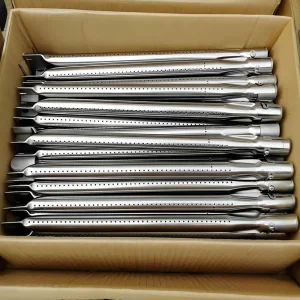
| 409L / 439 Ferritic | 10.5-11.7% Cr, Ti-stabilized, Low Ni | ≥ 380 | Moderate-High (Thermal resistance) | Heavy-duty structural bases, industrial grill table frames. |
Tier-1 furniture brands, hospital group procurement networks, and industrial equipment builders mandate strict compliance metrics when vetting overseas table stainless steel leg factories.
Every structural tubing heat must be supplied with EN 10204 3.1 certification verifying chemical composition via optical emission spectroscopy and physical mechanical properties (yield, ultimate tensile strength, elongation).
For load-bearing table bases, plasma/TIG welded tubing undergoes internal bead removal (planishing) and argon/nitrogen purge protection to prevent interior seam oxidation, micro-fissuring, and fatigue failures during CNC bending.
Electrolytic polished or mirror-finish (600# grit) surfaces require sub-micron wall consistency to guarantee electroplated chrome, brushed nickel, or vacuum PVD titanium gold coatings adhere without flaking or color variance.
From raw stainless steel coil slitting to automated CNC fabrication, modern export mills deploy integrated workflows that eliminate intermediate processing costs and guarantee structural reliability.
Production begins with cold-rolled prime coils sourced from tier-1 steel mills (TISCO, POSCO, Baosteel). In-house high-precision slitting heads ensure strip width tolerances within ±0.03mm. Automated multi-pass roll forming shapes the strip into closed tubular geometry without introducing localized stress work-hardening.
Seams are fused using continuous plasma/TIG welding heads monitored by real-time infrared temperature scanning. Internal nitrogen gas purging shields the hot heat-affected zone (HAZ) from atmospheric oxygen, preventing interior chromium oxide depletion and ensuring the tube interior remains free from black oxidation scales.
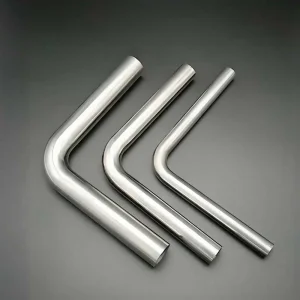
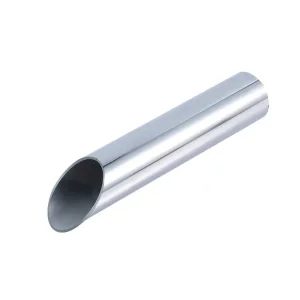
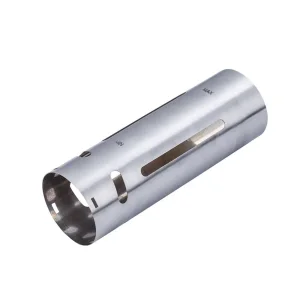
Factory fabrication lines integrate multi-axis fiber lasers to cut mounting holes, slot tabs, and mitre angles directly into tube lengths with zero burrs. CNC mandrel bending machines achieve tight center-line radii (CLR) up to 90° without tube flattening, wrinkling, or seam splitting.
Tubes undergo automated multi-station mechanical polishing (from 180# satin brush up to 600# optical mirror finish). Acid pickling and chemical passivation remove free iron particles from fabrication steps. Finished legs are individually PE sleeved and wrapped in heavy-duty reinforced corrugated crating.
Fulfilling wholesale contracts internationally requires comprehensive regulatory management, custom clearance documentation, and ocean freight protection protocols.
Fabbed table assemblies adhere to international standards including ASTM A554 (ornamental structural tubing), EN 10217-7, JIS G3446, and REACH / RoHS non-hazardous surface chemical regulations for indoor healthcare and educational facilities.
Leading export partners provide flexible supply chain routing, complete Rules of Origin documentation (Form E, Form F, Certificate of Origin), and transparent HS code classification (7306.40.00 / 7306.61.00) to streamline customs entry.
To prevent salt vapor oxidation, scratching, and transit bending, products are protected with anti-humidity desiccant packs, VCI (Vapor Corrosion Inhibitor) plastic wrapping, solid wooden crate framing, or heavy-gauge steel racking systems.
The future of wholesale table stainless steel legs manufacturing lies at the intersection of automated quality control, low-carbon alloy production, and advanced physical surface treatment.
Integration of real-time machine vision laser profilers on high-speed tube mills. Machine-learning algorithms scan 100% of outer diameter profiles and surface reflectivity, automatically adjusting forming rolls to eliminate manual inspection latency and prevent dimensional drift.
Adoption of stainless steel coils produced via Hydrogen Direct Reduced Iron (H-DRI) electric arc furnace (EAF) pathways. Overseas factories are transitioning to solar-powered manufacturing plants to assist global brand partners in achieving Scope 3 carbon reduction targets.
Development of ultra-thin hydrophobic and oleophobic nano-silica ceramic coatings applied via automated spray lines over satin and mirror finishes. This innovation maintains the tactile metallic aesthetics of stainless steel while eliminating smudge visibility in high-traffic commercial spaces.
Direct answers from our metallurgical and export engineering team addressing critical procurement decisions.